Showing posts with label travel tips. Show all posts

Wednesday, March 18, 2015

the riads of Fez

View of Fez from our riad
Fez was a bit more intimidating a city than Chefchouen or Tangier, and after the little bus ride of horrors, it was much more tiresome to confront. We wanted to just get to the hotel as fast as we could, preferably without the penguin-waddling, angry British girl that ruined our vomatarium bus-ride of fun. The bus seemed to circle around the white-walled medina of Fez an innumerable amount of times - or at least that's what it seemed like with the walls making endless eddies inwards and outwards, unidentifiable for lack of features and gates. This was something new and incredible. On the medinas we had visited previously, the city was on both sides of the wall, having long since out-grown their artificial barriers. But with Fez, the city was well contained, partly  because of the creeks and cliffs that surrounded the old town and partly because the “new town” was quite in a separate geographical place.
That said, when we stepped out of the bus, we opted to head straight for the first taxi that wasn't chasing us with shouts of "Hey tourist!" Dodging that immediate squadron, I was able to hail a taxi in the parking lot. As I stumbled around with my very limited French the guy stared at me and then drove off. No luck there. The second guy I was able to talk to agreed to take us close enough to our hotel - being in the medina, taxis can only really take you to two main squares and you're on your own with GPS and Google maps from there. He agreed to take us for 20 dirham, which is about 2 euro. Even less than I had been willing to offer, and was less than what would have been my offer - it’s my rule to let the taxi drivers set the anchor price. I decided it best not to argue with already favorable terms. I gave him the difference as a tip, since it's always a refreshingly rare thing to deal with a nice guy in a cab.
Cinema Amal gardens and the Palais de Fes riad and restaurant (great restaurant!)
He took us all the way to the plaza with the Cinema Amal. I'm not actually sure what the place is called, since Google maps isn't overly clear on the issue. It seems as though, when labeling the medina, they trusted in tossing darts blindfolded at a map on the wall. Unfortunately, Google maps is not so open source, or I'd just go in and fix the more glaring mistakes there are, but as Obama once put it, "That's above my pay grade." As it is, the taxi driver took me to a place where we agreed could have been either Rcif plaza or where the Cinema Amal is "just over there". My GPS though was right on with La Riad Maison Verte, which was our destination. We grabbed our bags and dove straight into the alleys and tunnels that so define the Moroccan medinas, using the cell phone GPS as a kind of ball of string in case we disturbed a minotaur. Finally, we were able to get the Riad in the general area of the blue circle on my Google maps, then relied on some signs that were occasionally stapled to this corner or that, and then we successfully passed the unmarked wooden door twice, until I realized, "Ah, that's a really nice door and it's close enough to the signage, yeah?" When you're walking down the alley though, it does not look like an entrance to the nice hotel that it is, it just looks like a door to possibly someone's house, or possibly a camel market, or factory, or who knows what the hell is behind any of those doors in those bare walls of the dirt encrusted Fez medina. And therein lies what is awesome about Fez. (note: the plaza with the gardens is what's referred to as the "Cinema Amal", and if you tell a taxi driver that, that's where he'll take you.)
The courtyard of the Riad de Maison Verte
The entrance of the Riad takes you into the courtyard, a beautifully tiled shaft to the sky above, around which the rooms look down into the courtyard. There are various doors and passageways that lead up to the rooms - there are two rooms on the groundfloor that don't provide much privacy, as the windows open up to the courtyard seating area. The rooms are all fairly small - we thought ours was a hallway, until the placement of the bed made us fully understand that that, actually, was the whole room. But it was also immaculately decorated, with intricate tilework and wood carving throughout. One can easily imagine being from earlier times and seeing this as a place where minor nobility and upper class merchants might have stayed during their presence in Fez.
The rooftop of the Riad
A "riad" though, wasn't traditionally an inn - though it could have been. It was traditionally a house or a palace, with the courtyard serving as a focal point - hence the term "riad", which is Arabic for garden. The Moroccans started this style of house as an inheritance from the Roman days, with the ruins at Volubilis showing some fine examples of the ancient system. Many cultures today preserve the style too, from Romania, to Georgia, and - though I haven't been - probably in Italy, often bearing the term "Italian garden" or "Italian yard." The style leads to the surreal street design, where the windows are lacking on the lower outer walls, which allows for tighter streets without a loss of privacy. And privacy, is probably the number one factor in sustaining the style, in that Islamic culture holds it at a huge value. With a truly private place, and with a nice interior garden, the women can disrobe and relax without having to worry about the conventions of modesty and manner that she must worry about outside. Many of the riads of old have since been restored and made into hotels, so keep in mind that it's something akin to having a room in a house. Whereas the family's privacy is certainly kept, the individual's privacy might not be so much. That in mind, I would still suggest choosing a riad to stay in while traveling in Morocco, to truly get a sense of how the ancient Moroccans fared and lived, and to get a taste of authentic Moroccan architecture and style.

Monday, March 9, 2015

the blue pearl

The bus took a windy road through the Riff Mountains to Chefchouen. The mountains there weren't huge, but there was a beauty hanging from their sheer brown cliffs. We entered the suburbs of town, looking out the windows in some dismay. There is no majestic entry to the city, as the road first hits several outlying villages. The houses are nice - they weren't slums that we passed through - but neither were they the idea of the beautiful, isolated touristic setting that we had originally imagined. At first, we thought the small towns near Chefchouen were supposed to be the place itself; let down, thinking, "I thought it was supposed to be all blue." But then, around one bend, we finally saw the city. The blue part, the part of town that gave it the name "The Blue Pearl", is bedded between two mountains, making it seem as though it's isolated from civilization, though in actuality it's surrounded by small, growing and modern towns. The modern town of Chefchouen - where the bus dropped us - seemed to be a construction project, and a new tourism booth was set up right on the main road. We had asked the guy there about the bus on the following day and he let us know that that was the first day the tourism booth had been opened, so he was quite excited to give us advice. The advice is that the CMT bus tickets are sold right up the street towards the medina, and to buy them in advance, because they sell out quickly, as per my last post. 

Place Outa El Hamam at night
From where the bus let us out, we found a taxi and took it to the main square in the medina, Place Outa El Hamam, a fairly romantic square with one side taken by a steep walled fortress and the other sides by outdoor cafes, chairs and umbrellas spilling over the cobbled plaza. From there we had to make our way through the initial blue bends and turns - everything blue, as though there were an effects switch to tint everything blue in your eyes - and finally up to the Casa Elias. With even that just short walk, we were already excited to see the city

Our window at Casa Elias
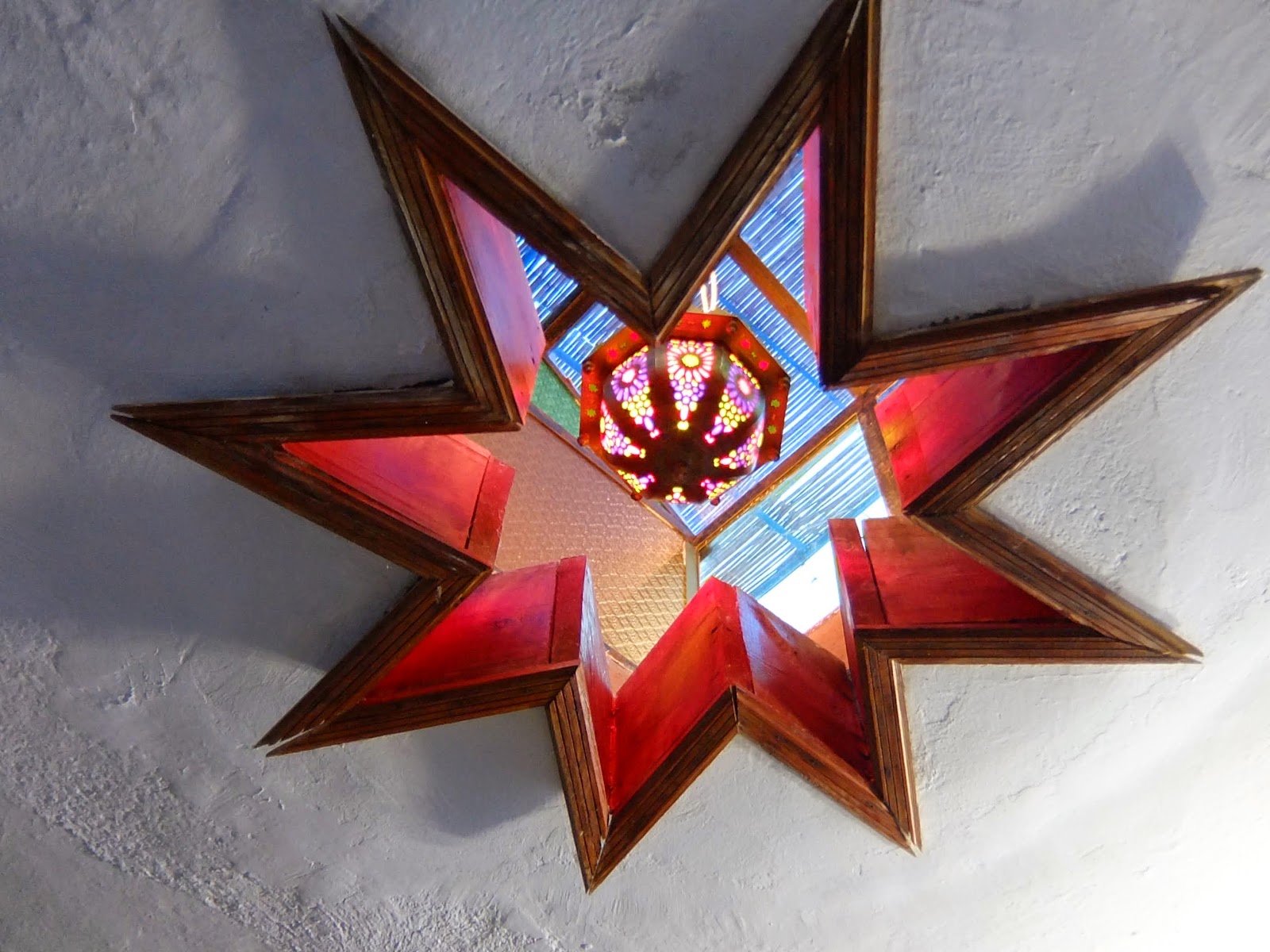
The Casa Elias was a nice place, run by quite an active young Moroccan man who speaks excellent English and has quite the entrepreneurial spirit. The housekeeper, who greeted us, didn't speak a lick of English but could speak French and Spanish and was more than happy to try to communicate with us, especially with the phrase, "Chambre o suite?" repeated over and over. Not really knowing the difference, I just kept saying, "Oui, en le internet, je suis Saint Facetious," until she at least just showed us what was either a chambre or a suite and then we agreed on it. The place, though on the fourth floor, looked and felt like a beautifully decorated cave, with even the bed carved of stone or hardened clay or mud that blended into the floor and ceiling. The single window was in the rooftop, shaped like a star, and there was stained glass above that, filtering in colored light to the room below. The bathroom was a bit dank and smelling like a cave, but what could you expect from such a construction? Something told me that everywhere throughout all the hotels was the same. The rooftop, where they serve breakfast, has a really immense view, looking down across the medina. For that rooftop alone - and really, the room was really neat - I would stay there again.

A view from the Casa Elias patio
Chefchouen itself, as I mentioned before, is a blue city. This is by no means an exaggeration. All the tourist manuals are true. The entire medina is painted in various shades of blue - a few buildings got lazy and are stucco white, and there is an occasional red bricked building - usually a landmark, like a castle or a mosque, but one can't be too critical. Most of the streets are wide enough only for one or two people, and one gets the feeling you're in a real fortified city from the medieval days. Apparently, one hundred years ago, it was a green city, and Christians weren't allowed to enter on pain of death. But then the Spanish took the town, forced them to allow Christian tourists, and then the Moroccans - the quick learners that they were - realized that they would be better off taking filthy European and American money from tourists than beheading them. After the Spanish freed up the town, the residents decided green wasn't such a nice color and unanimously decided on blue. I’m not sure what sort of bureaucratic HOA had to head itself over that change of decor, but however  the process went, it was quite successful.    

A street in the medina
We spent the rest of the day exploring the azure labyrinth, going from cafe to cafe, drinking up the hot sweet mint tea and tasteless coffee that are both ubiquitous in Morocco - my advice, stick with the tea. At one place, I enquired about smoking some nargile - a tobacco water pipe.

"No, no, you can't do that hear," he said in a loud whisper. "The police are on about that."

"No, I don't mean hashish, I mean shisha. You know, tobacco."

"Yeah, they've really been on about it. You want to buy some hashish though? I can do that. Maybe come back later tonight and I'll have some for you."

Another street view
Strangely, marijuana seemed to be ludicrously easy to get in Chefchouen, with every waiter and guy walking down the street offering to sell some, though just a common water pipe was impossible to find. I understood that my quest to find a relaxing cafe to chill at and smoke water pipe was over. Later, in Fez, I read an article about how the police had been cracking down on cafes and bars that served shisha, as shisha smoking apparently caused women to become loose and to lose their morals. I facepalmed myself on that one, not realizing why that logic hadn't been so clear before.

In all, we only spent that one night in Chefchouen, though I do wish we could have spent maybe one night more there - though the lack of shisha would have made it daunting to find things to do. Good hiking can be found, and rumor had it there was a big waterfall to see, though hikers are also warned about the large plantations of marijuana out in the hills and along trails. Picking the stuff off farms is frowned upon, and you should probably talk to the guy carrying the machine gun about buying some, rather than risking his wrath.


View from a restaurant

Thursday, March 5, 2015

on the ride, the vomit, and the entitled English girl

At least not during tourist season, it's possible to travel through Morocco without thinking much about the transit options. Trains traverse the countryside, connecting the coastal cities and Fes and Marrakech, while buses are the main mode of transit through the middle country. The buses are either remaining from the heydays of the 1970s extravagance that Morocco probably didn't have, or - and this is more likely - they're hand-me-downs from what was being used in Germany and France in the 1970s. Either way, they're old and they smell old, something like your grandpa's car if he were an aging Mexican migrant worker in California, constantly in-and-out of mythical free-for-illegals healthcare facilities. That is to say, they smell something between moldy bathrooms and a Roman vomitarium. There is one glaring exception and that's the CTM bus line, which sports brand new buses that have restrooms and possibly even wifi. The CTM buses look so nice that when they enter, you can see them shining and glowing, and your heart lifts up thinking that yes! my bus has arrived and it's not one of these dilapidated messes! but no, actually it's a CTM and you didn't book your ticket in time to ride that glossy, shining mother of buses. This is to say that you must absolutely book a CTM bus at least one day in advance - and this is not during tourist season, so maybe even a week in advance during the summer. You can book them online or you can ask your hotel about the most convenient place in town to book them - they often have offices near medinas.

A medina street in Tangier. Not so good for cars.
CTM buses are absolutely the most comfortable, though they might not be on the most convenient of times. The one from Tangier to Chefchouan doesn't leave until 1:00, so we decided to tempt the fates and just show up at the bus station. Getting to the bus station went without much of a problem. We left the hotel and the medina - cars can't fit in any medina really, as some are even difficult for average sized humans to fit shoulder-to-shoulder, imagine that with a brass or lamp vendor crammed in there somehow. From there, we went looking for a taxi and was immediately met by a tout who started pestering us, "The medina is this way, I'll show you. Or maybe you want a restaurant? Or taxi?" This behavior can be cute on an 8 year old, but when the guy is in his twenties, it resembles something more like harassment, but he probably grew up doing this, and took that age barrier for granted.

"No thanks, we'll get our own."

"I'll get you taxi."

And we kept walking away.

"Fuck you!" he shouted after us. Oh hospitality, how I love thee.

In the cities, taxis really are the best form of transit. They cost a bit over double a local bus - which is to say, cheap - and they're not at all confusing. You have the ideal chance for getting lost in the tight concrete and brick canyons of the medina, so don't worry about forfeiting your exploration time either. The bus station is called the "Gare Routiere" in every city, so this also makes things easy.

The bus station in Tangier seemed like it should be a stall out in a small desert village - everything's dry, dusty and worn looking, though still fairly clean - and it's filled with old Moroccan people shuffling around in a design between lost and waiting. The men tend to wear either jeans and jean jacket or a more traditional djellaba, which is a long wool coat with a pointy hood that they usually wear covering their head, so that the waiting areas tend to look like a Jedi Knight convention. The women often wear something similar to the djellaba, though slightly more elaborate and fanciful, and seem to only wear hijab to keep from getting cold - as both groups are keeping their heads covered in winter, it hardly seems something oppressive in Morocco, especially when plenty of women can be seen at cafes and street-sides not covering their head.

We found a bus leaving in thirty minutes, at 10:30, so we opted for that one instead of the CTM - which was probably sold out anyway. The bus wasn't so bad, except for the olfactory festival aforementioned. It took about 3 hours without incident, and dropped us off on a random street in Chefchouan, where we took a taxi to the medina and walked the rest of the way to our guesthouse.

The wife not enjoying waiting at the bus station
When we were leaving Chefchouan, we stopped by the CTM office which was right near one of the lower exits of the medina. Here we discovered that it would have been better to book the day before, so again we had to chance our luck at the bus station. The Chefchouan bus station was quite recently built and had a never-been-used-before fresh-out-of-the-package look and feel. Actually, much of Chefchouan outside of the medina had the same feel, with a surge of construction going on, hotels and apartment blocks alike being built full speed ahead, and everywhere resembling a prosperous vacation town, with even the poor districts looking nice and comfortable, though everything looking slightly empty. Ghost towns freshly built from the dust of nevermore.

We had to wait at the bus station for about one and a half hour and our bus came a half hour after that. Here our luck had run thin. The scheduled three hour ride would turn into six, and all the seats were broken in one manner or the other - recliners permanently reclining, arms swiveling and not locking, holes, mold, broken windows, rude, entitled English ladies, etc. The boy running the bus held his nose in the air, as though he knew the people riding the bus were low class and he was above them - nonethematter he was at their service - but he was friendly enough and loaded on the luggage. When he set a British girl's luggage on the side, she immediately scolded him, "Not that way, turn it over now! Ungggh! No, the other way. No, God, the other way! Unggh! Er!" and then she got on board with all the waddling and flopping of arms of a penguin.

We got on after her and found our seats. The only pair of chairs available were a couple behind hers, so we took them. After about thirty minutes in was when the real fun started to happen. The small child riding with his parents behind us started throwing up, emptying his last three days of food (hopefully) into a bag, though it was possible right onto the floor. I kept imagining vomit flooding across the floor as the bus braked, as though it were the ocean tide rising up, coming in rolls, washing away sandcastles, luggage and boots. And then, an old grandma just ahead of us, started her own gastric warfare. The smell of the autobahn vomitarium nearly became enough to force everyone to join in the action, but at least there was the ceiling window open. Thank God, at least there was that. But the English girl wouldn't have that, and she asked for the nose-lifted attendant to close it.

"You do realize people are vomiting here, yeah?" I asked her, trying to hint to her that maybe closing the only form of ventilation might not be the best idea.

"You do realize my head is about to blow off from the wind. If there are people vomiting here, it's not my problem."

I grunted.

At some city, the bus stopped and she got off. I thanked God and so that we might have control of the window, we switched to her seats - her companion seat was taken by an old lady who had left for good. When the bus was about to roll off, she came back on. Well, there were plenty of other free seats she could take, yeah?

"You are in our seat," she told me. "We only got off for a moment and you took our seat."

"We?" I asked her, looking for the other person. I didn't expect a conversation with a schizoid. But try to keep it civil. "Yeah, well, I didn't know you were coming back and maybe we could switch seats and I could get blown around by the window and you wouldn't have to worry about it."

"I'm not asking for you to switch back," she said, her voice dripping with disdain like a vindaloo drips with sauce. "I'm telling you. It's our seat."

Again with the "our"! And now she's just not being civil, so all thought of mercy dropped off of my radar like a hot air balloon unloading it's weights. "Seriously, it smells terrible here and I need the window open, just please -"

"You are an asshole, you took our seats!"

"Look, when I asked you earlier to open the window because of the vomit, what did you say?" I paused, trying to remember myself. "Ah, you said it wasn't your problem right?"

"I didn't say that to you, I said it to the guy next to me."

"Right, that was me," I said.

"No, it wasn't. I said it to the guy next to me. Get out of our seats! Those are our seats!"

"That was, nevermind. It's not my problem. There are other seats."

"But those are ours!"

"Not my problem," I said. Those words did kind of feel nice. They were a kind of release from the world of sweat and vomit and whatever else was going on in that carnival of vile smell.

"You are a real ass hole, you know that?"

"Not my problem." Yes, this was getting fun. One more time, please!


She huffed and puffed and luckily I was not sitting in a straw house for her to blow in, since the fuss she was making clearly was so that I would give some damn that I didn't. Then she gave up and sat in the empty seats directly behind us, so that she could glare at me for the rest of the entire trip. Whatever, three hours of glaring, I could deal with that, as long as I had that cool, brisk wind stroking my face, keeping out all those nasty little smell molecules from my nose.

Monday, February 23, 2015

things to do in Tangier

We needed some more cash. The place at the airport was a complete rip off - one stand that is a chain at most airports. You typically lose about 40 percent of the value of the money using their rates, and only after arguing will they knock it down a bit. Best to always carry a converter with you and know how much your converting and how much it should be. The exchange will naturally be a bit off the published rate - that's how exchanges make money - but they should be reasonably close to that rate. We found a place near La Petit Socco, or "the small bazaar" in French, that offered an almost exact exchange rate, something that for me is a rare occurrence, but seems more common in Arabic countries - beware Spain and the Czech Republic, countries that can be overly sneaky on their exchange rates.

Going from euro to dirham, you end up with a gigantic wad of cash, feeling like a rich man ready to throw money into the wind. It's a great feeling, but soon it becomes annoying when you realize it means all your pockets, secret pouches, and wallet will be left bulging for the rest of the trip. A small price to pay for wealth.

Les Files du Detroit
We then found the Kasbah, through the diligent use of my smartphone. Only for one hour was my Google maps application a bit confused, but finally it was able to guide us correctly to our destination. The entrance to the museum was three dirham, or thirty cents, and the smallest we had was twenty. The attendant refused to allow us entry, claiming that he didn't have change. So we looked around for a tea shop to sit and have some tea and thus get some change. There we found the pinnacle place of Tangier, Les Files du Detroit, or "the Sons of the Straight." It's quite a small place, one long room, that's quite ethnically decked out with pillows and beautifully carved woodwork. Instruments hang everywhere from the walls, and a small man was sitting on a pillowed bench, wearing a Fez and playing a Moroccan lyre, singing some song that sort of resembled Arabic music and sort of resembled jazz. When he finished, he stood and offered us some tea and showed us his record, which we bought (and is great). After serving us tea, he had us do some silly touristic posing underneath his instruments wearing some more red felt Fez hats, but then relaxed again into his singing meditation. After we were done, I told him about our problem with the museum, and he took us over and got us in without a problem.

I later found out that musicians often gather at Les Files du Detroit at night. As we were only there for one more night, and were still a bit weary of the medina - it truly feels like an altogether alien culture - we didn't manage to make it out to see any jam sessions. So, to any traveler there, find it at night and be sure to toke on some local herb while listening to some live jams - or join in, there's plenty of instruments lying about.

Some guys playing a tune at Le Files du Detroit:


Inside the Kasbah
The Kasbah is a bit of a ruin and not much of a museum, but you can at least see the main courtyards and hallways, and imagine how beautiful it once was during the days of the sultans. The woodwork and the tile work - more of which seemed to be the standard throughout Morocco - were stellar in their complexity and skill. The palace was a good introduction to this, seeing everything in place and style as it was meant to be. From the Kasbah, there's also a nice view of the bay, where one can imagine the sultan and family drinking tea and looking out across the sea, preparing to purvey the rest of his empire in Spain, or perhaps dream about that lost empire, depending on the century.

Some of the ceiling woodwork 

One of the inner courtyard gardens.

Ceiling tile work and a typical lamp

The palace minaret

From there, we went on to the American Legation. As I mentioned before, it was an early gift of the Moroccan kingdom to the United States of America, and is today the only American government owned historical landmark outside of the U.S. Morocco was one of the first countries to recognize the Declaration of Independence and give good favor to the newborn republic. At this period, Morocco had just finished a long civil war, with the new sultan eager to gain economic wealth through trade, and sought out a positive relationship with the United States even before the War of Independence was won. In 1821, the Sultan Moulay Suliman gave a two story building, decorated in traditional Moorish style, to the American government, where it was used as an embassy, consulate, and finally, Peace Corps office, for 140 years. Now it's a museum, showing this long history, including a wing dedicated to Paul Bowles, the beat writer who lived in Tangier, and all the other beats who had visited.

The building itself is snuggled in a very residential corner of the medina and it's easy to think you're going the wrong way while you're en route there, which is precisely what happened to us. I was quite convinced we had taken a wrong turn, or the guy at the cafe over on La Petit Socco had misguided us - remember, it's always best to ask someone busy doing something else for directions, otherwise they'll tag along and expect a tip - but finally, we saw the small sign hanging off a wall in the street. The streets in this part are narrow, so it's perhaps better to call all of them alleys, but around any bend can be something unseen and beautiful, palatial courtyards hidden away like the hair and body of a devout Muslim woman - pleasures for only the few.

The museum is definitely worth the find. Whereas the Kasbah is a great example of a dust covered, ruined architectural wonder, the Legation is kept up so that it looks exactly the way it would have looked a hundred years ago. The very same tables that those from Thomas Jefferson to Paul Bowles would have sat at in a meeting or an exhibition, all there, polished and shining, the same as they ever were, the woodwork and tile work all exhibited in a remarkable level of historic preservation. If only there were a cafe out on the patio, it would be the perfect place to spend a whole day writing and watching the people pass along the alleys below. But lacking such a cafe, touring about the place takes up all but 20 minutes.


The courtyard of the Legation

Looking down at an alley from a bridge

Inside the Paul Bowles Wing

Some more tile and wood work

With so much time left over, we decided to leave the medina and see what Tangier was really about. Which wasn't much. Along the waterfront were weirdly glitzy hotels, the kind I've seen all over seaside towns in developing countries, where they were superficially fancy, as though they were fancy only to those who didn't really know what a fancy hotel was. Up the hill, there's a run down terrace, called the "Tanger Boulevard", filled with cafes that are also a bit run down, but have a beautiful view of the Straight and of the medina. Near there is the Tangerine, where the beatniks once hung out. Since then, it's been a gay club and now a somewhat seedy place that seems surrounded by a trash dump and dark eyed men staring at anyone who would pass the place. There is a nice boulevard above that, Avenue Pasteur, with several modern cafes that are good places to drink coffee and watch people, but are lacking any real character. The first we sat at was called "La Espanola", and was complete with a large mirror and the cafe's name spelled out in rhinestones. Rhinestones always spell class. 

Touring these coffee shops was pleasant, but satisfied enough of my curiosity about what Tangerines did in the evening. In all, it was neither a horror story or a fantasy, just a fairly normal Arabic town with some beautiful views. And at any rate, Tangiers from a view is an extraordinarily beautiful town. It's only when you're actually in the White City that it doesn't quite live up to the senses. It's probably best then to stay in the medina and sit at Le Petit Socco, drinking the sweet mint tea and letting the day pass away to the hum and bustle of tourists fresh off the boat and hustlers looking for an easy pay day. Or with a few extra days, to make some trips out of town to the villages that dot the coast.

Sour Meegazine Square

View from Sour Meegazine

View from Tanger Boulevard


Down Rue de Murillo

Tuesday, February 10, 2015

touts, thy days are numbered

View of the medina from our the Hotel Continental
I had mixed impressions of Tangier before we arrived, not really knowing what to expect. On the one hand, it was the Interzone, the safe haven for past beatniks to hide and get high, full of drugs and gambling and prostitution, but on the other hand, it had had stable rule for years now, and the King had recently infused large amounts of cash into the economy to help fix things. I had an image of the former burned in my mind, of a crumbling medina full of dirty street beggars, snake charmers in small squares distracting people while they were as charmed as the snakes while boys in rags pilfered the contents of tourists' pockets. Travel sites with reviews by travelers from the States and Europe are overwhelmingly negative on the city, saying that it was the worst in Morocco and that touts - guys who make it their business to lead you places and then charge you money - abound and everyone is trying to scam you. So it's with this mentality we entered, and one might ask, why on Earth would I go to a place if that was my preconception of it? But then I would answer back, why wouldn't I, sounds amazing!

Interior of the Hotel Continental
We were staying at the Hotel Continental, which itself is like a museum of architecture. It sits on an overlook of the bay, where you can sip your morning coffee on the balcony, looking across the Tangerine resorts and apartments stacked along the shore and watch the huge cruise ships sitting at wait, unloading or loading passengers into rows of buses and taxis. The breakfast was more than expected - a continental breakfast, but also with fresh pancakes, jam and lots of tangerines - hence the name of the fruit.

After breakfast, we went out to explore the medina. I had three goals in mind - to relax at some coffee shops and soak it all in, to see the Kasbah and the American Legation museums, and maybe perhaps to see a place where the American beatniks had hung out, like the Tangerine Bar, the walls of which are now adorned with the pictures of the famous writers who had once imbibed and found their pleasures there. It would have been nice to see some of the nearby villages and the Hercules Caves - said to be the place where Hercules rested from his travels upon reaching the pillars - but one can't see too much. If you see it all then you have nothing left for mystery and all is left for disappointment.

City street in the medina
The medina itself was beyond my expectation. It was the medieval center of town, buildings crammed together and surrounded by a wall, exactly how European towns had been before the days of the more established empires of Napoleon and the Hapsburgs, when they started clearing out ghettos and creating wide boulevards. Though it was much cleaner than I thought it would be. All the walks were paved and there were few pieces of trash in sight. In fact, the lack of trash throughout the Moroccan cities were a constant thing of wonder to me, given how crowded the living conditions in the medinas were and hence the impossibility of a decent sanitation system. But the locals were constantly cleaning - sweeping, gathering trash, etc. so that things wouldn't pile up - habits that themselves piled up over thousands of years. I can't imagine how things could be carried out, sense the medina tends only to be accessible by car through one road, and that one tightly so - vendors, shoppers, tourists, residents, holy men, and merchants all scrabbling out of the way when an automotive passes.

For the most part, we were left at ease while browsing through goods in various shops. Mostly, you can buy lamps, light covers, stained glass goods, tea and coffee pots, traditional clothes, and traditional shoes. And for the most part, outside of the younger generation who tend to wear blue jeans and white shirts, most Moroccans are still wearing their traditional garbs, which look something like what Jedis from Star Wars would wear, long robes with pointy hoods. The shopkeeper would come to us and stay a respectable distance, which was normal. None of the hassle that I had read about. We were only approached once by a tout, who kept insisting that he could take us to a square - which we had already visited and knew the way to. As we walked past him, he followed us and kept acting as though he were giving us a service.


Le Petit Socco, the main square of the medina
"La shukron," I kept repeating. "No thanks," in Arabic, in response to his constant offers of assistance to show us the way. Part of the magic of the medina is to get lost, and really, the Tangier medina isn't so huge to get terribly lost in. It's a perfect introduction to medina life if one is headed to Fez or Marrakech, both much more maddening and hectic. But with the modern smartphone and GPS, the tout's days are numbered even with the most ignorant of tourists.

With enough persistence, however, the tout caught my eyes. "Why are you so paranoid, man?" he said. 

"With reason, now excuse us."

Monday, February 2, 2015

the choices of travel

It was tough choosing places to go in Morocco. There is a great deal of cities that are of interest to both the wife and I, but I knew from traveling that you have to appreciate your time limitations. It's better to see one or two places well than to see fifteen places in a rush. You have to miss some things and at the end of the day, you have to realize that that’s okay. Maybe you’ll come back, maybe you won’t, but at least you can have a great and relaxed time of seeing some of the sights. To implement this, before we left, the wife and I sat down and wrote out a list of our top spots in Morocco and we shared that with each other. Then we looked at travel options - trains, planes, and automobiles - and did the best we could to respect each other’s wishes. It’s always best to add in the ideas of your partner, since there can always be something amazing that you could have never thought of, and likely your own ideas might end up stale and wanting.

The cities and things that made it to our list:

Marrakech (the wife’s list). It's the most well known of the Imperial Cities - or former capitals - of Morocco. It's also the most touristic and cleaned up, an attempt to give a bright, shiny, and happy view of an otherwise impoverished nation. That said, to see the best examples of the highlights of Moroccan culture, this is probably the city to see, with a cleaned up medina - or old town - and lots of hotels with preserved and interesting architectural flourishes.

Marrakech, credit to: www.corendon.com

Fes (the wife’s list). Not to be confused with the funny Turkish hat - though some people do wear the hat in Morocco, namely people involved some way in tourism. It's the other well known Imperial City and famous for its giant leather factory, where most of the handmade leather you find sold in European city streets comes from. Some people say it's also what Marrakech looked like before the hotel and tourism boom, and that there are still actual people living in the medina, which is also the largest in the Arab world, and can also claim to be the largest carless urban area in the world - the place though is quickly gentrifying, as many of those people are forced out by hotel developers and many prefer better living conditions that can be more easily afforded in the newer parts of the city. It's also known as the Mecca of the West and has one of the oldest Islamic religious schools.

A view of Fes from our hotel
Chefchouan, the Blue Pearl (my list and the wife’s list). It's a small mountain town where all the buildings are painted blue. They used to be painted green back when it was forbidden for Christians to enter the city on pain of death - at that time only Muslims and Jews were allowed to enter. But then the Spanish came and ended that practice, so for some mysterious reason, the locals changed the paint to blue.

A view of Chefchouan from a restaurant in the main square

Meknes (my list). Another one of the Imperial Cities, though one of the smallest. It's only got a mere 1 million citizens living in the city - but not in the medina, which is truly the smallest of the Imperial Cities in Morocco. The medina is supposed to be more charming and friendly than those of Fes and Marrakech, with the people of the markets not so pushy. Nearby is the ancient Roman settlement of Volubilis, which is open to the public for touring. This was one of the top sights on my list for that reason, as I’m somewhat addicted to seeing ancient Roman cities. The other top sight being...

Volubilis. Photo credit: tripadvisor.com

Tangier (my list). My wife had absolutely no interest in Tangier, but I was drawn to it, because of its deep connection with American history. For one, Morocco was one of the first nations of the world to recognize American independence, and even donated a palace to the American government for use as an embassy. The palace - known as the American Legation - is the only U.S. historical landmark located outside the United States. It's now a museum, dedicated to the long history - in American eyes, quite short history in Moroccan eyes - of friendship between the two countries. Tangier was also where most of the beatniks decided to locate themselves. During the mid 20th century, it was called the Interzone and was a kind of lawless, free territory outside of any legal jurisdiction. This meant that drugs, prostitution, gambling and any other number of fun stuff was going on, and so it was a natural draw for the beats, pulling in such residents as Paul Bowles - who would spend the rest of his life there - William Burroughs, Jack Kerouac, Tennessee Williams, Alan Ginsberg, among others. The city is also one of the oldest cities on the Mediterranean, being first founded by the Phoenicians - and there was probably a Berber settlement there before that - even before Rome's first foundation stone had been lain.

A view of the Tangier medina
Essouiara (my list). Orson Welles shot his "Othello" in the town, making the Moor of Venice authentically Moorish. It's among the oldest cities in Morocco, having also been founded by the Phoenicians long before the Phoenicians had even started writing things down and distributing alphabetical systems to the people's of the world. It later served as the main harbor town for Marrakech, and there's reportedly nice beaches, medina and castle there. Ruled off the list since it seemed better to visit when not in winter.

Daenarys looking down at the slave city of Essouiara
The Sahara Desert (the wife’s list). This is mostly in the south of Morocco, as the north is filled by the Rim Mountains and coastlines. There are lots of Sahara tours available from Marrakech and Fes where you can go play as a camel jockey for a couple of days or a week. Most tours are several days or more long, and a day trip really is only practical from Marrakech. Some parts of the desert are still dangerous due to banditry and the currently unresolved issue of the Western Sahara, though for the most part it's probably safe.

The Sahara of Morocco, photocredit: www.atlastrekshop.com
Those were our choices. The next step was to figure out how to get to Morocco, and let that decide where we would go from there. The cheapest flights from Prague to Morocco that I could find were on Vueling airlines with a stopover in Barcelona. I extended the stay in Barcelona - a city both of us wanted to visit - and bought tickets for the different legs, actually making the flight prices even cheaper, though not by much. The cheapest flights to Morocco were also from Vueling and went from Barcelona to Tangier, and from Fes to Barcelona. With one week to spend, that pretty much sealed our choice. We would arrive in Tangier, take the bus to Chefchouan, another bus to Fes, hopefully spend a day to see Volubilis and then make it back to Barcelona. We'd have to leave the rest for another visit, if Morocco deemed worthy of another visit.

But as we left the airport in Tangier, leaving that smiling customs official who nearly refused us entry based on their own error of not knowing how to read a passport, and how the taxi drivers had upped the price, and on my own experience with Arabs in Egypt trying to rip me off at every turn, I was beginning to wonder how this trip would round up. I'll prelude my review of Morocco with this: we will definitely return. And next week, I'll go over Tangier.    

Monday, January 26, 2015

a tangerine welcome

We arrived late in the night in Tangier. That was a bit unfortunate, since it was one day less we could see the city, but then it was one day more we got to see Barcelona, so as with most unfortunate things, there was a fortunate side. We landed at near 10:00 at night, and the passport line was quite slow going. There was one guy, a fairly modern looking fellow - that is to say, in pants, coat, and scarf - who was holding five passports. For some reason, his large family of women, composed of four large women and a baby, all sat past the passport control, tending to the baby. All of them but the mother wore a hijab, or headscarf, in the traditional Islamic fashion. My wife wondered about this, why a seemingly modern man would have his women in hijab, but I wondered if he even played a part in that at all. Unfortunately, Occam's Razor is not always so sharp and can often make a mess of things.

When finally we got up to the window, they looked at my wife's passport. For some reason it wasn't scanning on their passport machine. They looked at it closely, as though they were confused about the very existence of my wife's country, Georgia, and not quite understanding that indeed, it was a real country that existed apart from the United States. A bit understandable, since we handed the official our passports together.

After scratching his head for the fifth time, the official raised his finger and called another man over - a skinny guy with a mustache messily jutting out to the sky, waxed as though trying to imitate a Salvador Dali photograph. He took the passport and tried to scan it in as well and again it didn't work. "Sil vous plait," he said and he motioned us to where the large family was sitting. We took their seats, as now the passport check area was empty and nearly abandoned. "French? Spanish?" he said.

"English?" we replied in unison.

He grunted and frowned. "No," he said. "Uh, five minut." He left us and went to a back office, my wife's passport in his hands. Then he returned, much passed his five minut limit. The emptiness of the airport resounding with the echoes of the clicking of his shoes as he walked across the polished floor. "This visa, good, this passport, no good," he kept repeating, as though the extra time he spent in the backroom was spent rehearsing his new English phrase. "Ah, your passport?" he said to me and taking my American documents in his hand. "This passport good."

"But your embassy in Czech Republic gave me the visa," my wife explained.

"Visa good. Passport bad." Again his rehearsed phrase. He seemed proud of getting it nearly correct, as he was smiling as he said it. "Maybe you stay in Morocco three month, oui?"

"Ah, no," we answered. Maybe this was a form of strange Moroccan humor.

He then brought us over to the passport computers to show us his problem. He first put mine on the scanner. It read the numbers without a problem and brought up my information. Then he put in my wife's and put her country as Spain - which is where we flew from.

"No, I'm from Georgia. Not SpainGeorgia. Gee-ooorr-giiii-a."

As he re-conducted the search, I whispered to her ear. "Probably earlier they searched your passport as though you were an American." I laughed. It never gets old to me that people are constantly mistaking the country for the state, even when it's written on internationally recognized legal documents. If only the old president had insisted on his country being called Sakartvelo, which is how it's known in Georgian, this wouldn't be a problem. But unfortunately, American sports - and thus states - are often more well known than global politics, even by passport control officials.

The official laughed again and made one of his jokes that was more scary than funny. "Uh, maybe you want stay in Morocco for year?" He was holding my wife's passport, though now his hands were shaking. Was he nervous now?

"Look, is there a problem with the passport?" I asked, starting to lose my patience.

"No, no problem," he said, but not saying anything or doing anything more.

"So," I said.

"No problem, yes. Maybe Morocco for year, oui?" he said, still smiling and nodding his head.

"If there's no problem, can we have the passport and go to our hotel?"

"Oh, yes, yes, no problem."

"Passport?"

He handed the passport back to my wife and led us through customs. Then asked, "Do you need a taxi? Do you need me to take you to the hotel?"

"No, just tell us where the taxis are and how much to pay."

There is a sign posted with the standard night and day prices to different locations across town. He looked at it and told us it should be 150 dirham, since the night price for the medina was 150. We left the airport to the taxi cue, which was composed of a line of light blue taxis that were all the same make and model of a 1970s Mercedes, the car which Lada modeled their Jiguli after, so they looked quite familiar to me. It was like a flash back to Georgia, the country.

"Who's next?" I asked the group of huddled taxi drivers. One came up to me.

In French then Spanish - the language we settled on - he asked where I was going.

"Hotel Continental."

"Okay."

"How much?" - it's important to always negotiate ahead when dealing with third world taxi drivers.

"300."

"Um, the board inside says 150." I've had the same problem in Tbilisi, where the taxi drivers are always trying to get more than the legal amount. And again, the same problem, where the drivers were working in some sort of guild or bargaining unit, as none of the other drivers offered me the correct price and they all backed the guy I was dealing with.

"150," I repeated. "The sign, 150."

He gave off some explanation - my Spanish isn't nearly good enough to know what he said and my patience at this point wasn't enough to care - as to why the sign was wrong. "250," he said.

I sighed.

"Okay, I make you deal, 225, last price," he said. It was clear now that he wasn't going to budge, as we went back and forth a few more times and he wasn't moving. And seeing that it was night and there were no other cars or people there than this rank of taxis and these drivers who had halted from their card game to look at us, it really seemed that the last price should be taken.

"Fine."

The airport is some distance from the city and probably well worth the 25 dollar drive that it cost, especially at midnight when no one else was near and the streets of Tangier were possibly dangerous. Not having been there, I could give no real assessment except going with the guidebooks that claimed it was dangerous. As the taxi drove, he passed a few nicely developed resort areas and a luxury golf course until finally he arrived at the medina, circling around it, appearing like a walled fortress to our right and the Straight of Gibraltar on our left, glowing cruise boats floating in the distance. And then our hotel, which was hanging over the wall, looking out across the bay and harbor to the other side of Tangier. Then the taxi took a narrow, winding road into the medina, and another narrow road going inside.

"At night time, you can't walk around the medina. It's too dangerous, you should only walk during the day." Is what I understood from his Spanish. Likewise, he could have said, "At night time it's the only time you can drive because there're too many people during the day." I wasn't really sure which he was saying, but after we parked, I assumed it was the latter.

The entrance of the Hotel Continental
He dropped us off in the parking lot of the Hotel Continental. A guy from outside came up to us. "Hey guys, you want something to drink? Some tea or coffee? My cafe is right there."

I looked at the time. It was near one o'clock in the morning. "Maybe tomorrow. Do you have shisha? Some nargile?"

"No shisha man, but I've got hashish. You want to smoke? Come on man, my cafe is right here. And I live in that blue house above it. You want to smoke, just tell me."

"We've got to check in, maybe tomorrow, for now we're a bit tired."

"Yeah, no problem man, just let me know. Come by tomorrow."

View of the parking lot from our room

We left our Tangerine greeter in the parking lot and went inside the hotel. To say the place is magnificent is perhaps an understatement. The entire place is tip top with traditional Moroccan decor, wood and tile patterns everywhere that could fit. It was a scene from a grand hotel from fifty years or more ago, back when hotels were built with character and feeling, alien to this time period of mass production and IKEA. The place also smelled of the 1950s, a musky sort of we-used-to-smoke-lots-of-cigars-here-but-now-it’s-non-a-smoking-establishment smell. And indeed they have. The Hotel Continental is the oldest hotel in Tangier, and has historically been one of the most important, with people from Winston Churchill to Jack Kerouac staying there. Now it was but an old pale ghost of its former glory, but still a beautiful architectural wonder.

The clerk brought us to our room without a problem and then, without even waiting for a tip - something from my experience in Egypt I had assumed was impossible for Arabs - left us alone. The room continued in the architectural magnificence, with the wood work on the corners and the ceiling and tiles across the floor. The bed was also nicely crafted and there was gramophone in the corner, to add to the character - having no needle, the thing didn't actually work. The living area had some quite old and in bad taste couch and arm chairs, but that wasn't really anything to complain about, especially when the curtains were pulled back to reveal a balcony looking out across the harbor. For 40 dollars, we couldn't have imagine a better place, and it probably was my favorite hotel in all of our travel through Morocco.  

View from the room

Our room

Inside the Hotel Continental


Inside the Hotel Continental