Showing posts with label restaurants. Show all posts

Monday, March 30, 2015

the worse the smell, the closer you are


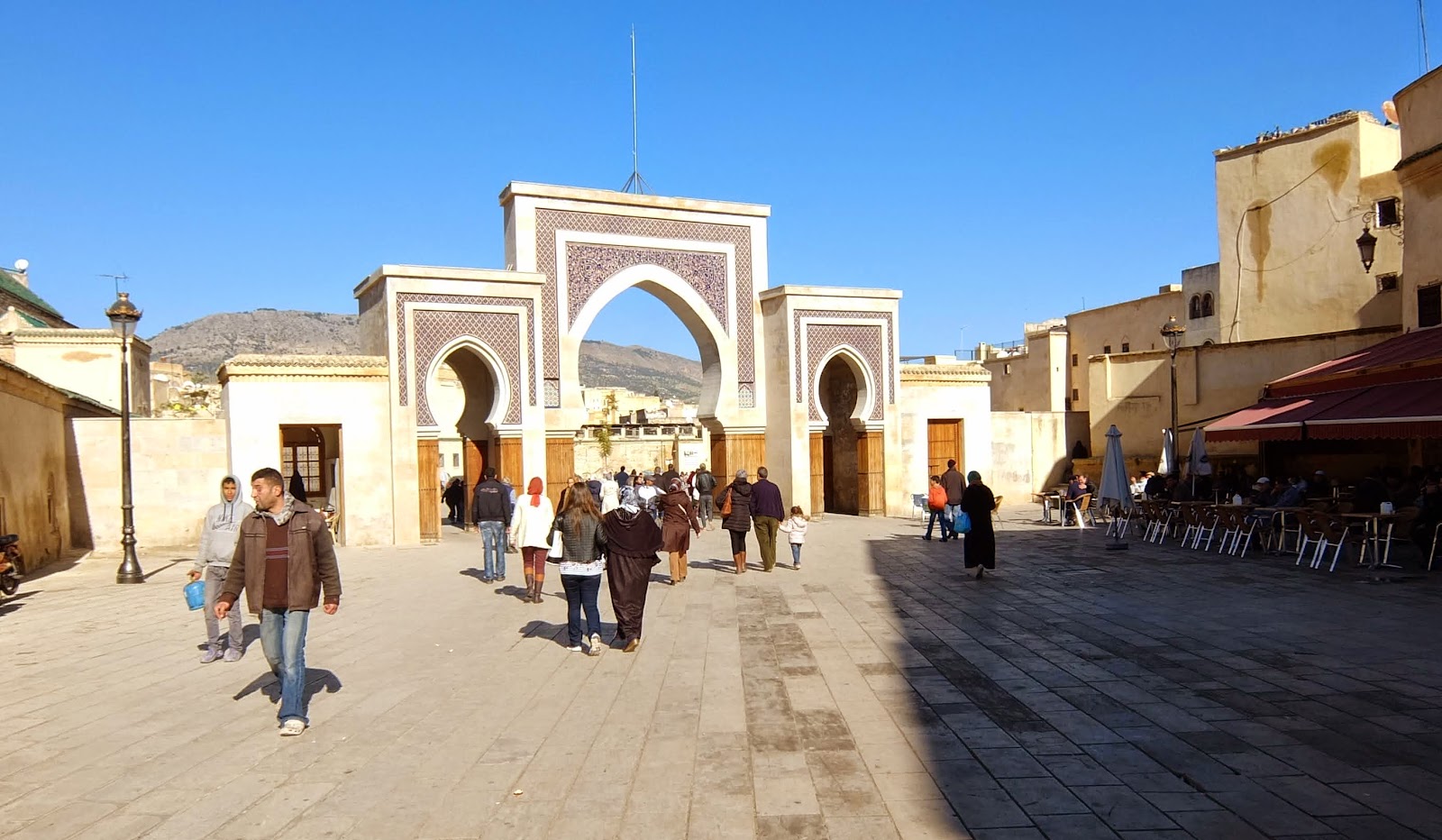
The Rcif square and gate to the medina
I'm still not overly sure on the dining options in Fez. At night, the medina is quite intimidating - the narrow walls of the streets magnify the mystery and horror - and the shrill screaming of random crazy people certainly add some kind of element that can't necessarily be described as comforting. This, of course, makes the offers of the various restaurants and hotels for a night custodian quite comforting, since if you're out too late, you can always just have the cafe or restaurant you're in give a call to your hotel. Though our Riad had this service, and we used him New Years night, he didn't really seem eager for tips, so one didn't have to worry about that - he just dropped us off and quickly disappeared. We did make sure to tip him at the end of our trip, as the same guy was all sorts of helpful in arranging things during our stay. 

The Ruined Garden
We did find one cafe that had great food and an excellent outdoor garden for eating, kind of an oasis in the alleys. It was called the Ruined Garden. The service was exceptionally slow, but then we were there on New Years Day, so that could have had an effect, as the staff must have been up all night cleaning up. The food and juices were excellent though - and by the way, drink juice in Morocco. Always fresh and always cheap. The atmosphere in the Ruined Garden can't be beat, with greenery sprouting out of every crook and cranny in what appears to be ancient ruins behind high stone walls.

I mentioned before that recently in Morocco, there had been a movement to discourage young women from the lascivious activity of shisha smoking, so shisha bars had become absurdly and un-stereotypically harder to find, even in such a large city as Fez. Queries to the hotel staff were left in ignorance and simply an offer to use the house water pipe. The waitress at the Ruined Garden had tipped us off to one place, the Fez Lounge, which was "Right down the Talaa Kebira." Well, despite going right down the Talaa Kebira, or possibly it was the Talaa Segira or the Zkak Roua - really, they all look like the same windy narrow alleys with occasional hints of sacred glamor from tiled towers and minarets - we couldn't find the Fez Lounge. My next object was to find a hookah water pipe souvenir, but besides some crappy ones clearly imported from Egypt, there didn't seem to be much of those on sale.

A main street in Fez
If you're going to Fez though for bars, indeed, if you're going to Morocco for bars, you'll be sadly disappointed - and you'll have had quite eccentric expectations for a Muslim country. Indeed, the real activities you'd go for in Fez have more to do with wandering around the medieval medina, making your way through the bustling crowds of students and merchants, tanners and lamp makers. The medina seems impossibly busy - mainly because the amazingly narrow streets are the only thoroughfares - but eventually one can cope with it, understanding that there are basically two main avenues, and everything else sprouts out from those two main avenues. Once people start becoming sparse, it probably means you're heading into somewhere you probably shouldn't, and the feeling that the sudden stark emptiness brings to you is of a dark foreboding that possibly you should follow, especially as some hijabbed lady comes out at you and tells you to go back now and that the main street is that way, not this way, especially not this way, don't ever go this way.

Those two main avenues are filled with trinket and souvenir sellers, who aren't overly pushy. Occasionally children tried to lead our way, and we let one guide us back to Rcif, mainly because he was a cute little guy and made fun of my beard. They're not being cute or helpful for free, but for small tips, so understand that. There is little kindness for outsiders there that doesn't involve tips.

Drying and dying some leather
The main touristic draw - also being, strangely, the main thing that the local goverment isn't aware of being a touristic draw - are the tanneries. That's why people go to Fez. The government keeps talking about moving the tanneries outside of the medina, somewhere far from town, since the smell is a bit overwhelming - to cure leather, one needs to dip the skin in piss and poop, both things not of what most would describe as having pleasant smells. Despite this though, it would be an absurd mistake to move the ancient tanneries, since that's the main thing to see. Tourists certainly aren't coming to see the oldest Islamic university in the world, indeed, possibly the oldest university period in the world - because non-Muslims aren't let in there, and even when you're just on the outside of it, you'd never know you were since the walls and avenues, to the untrained eye of the visitor, all look the same. Or at least they vary enough to make everything seem an undefined blur.

A cat helping dry some leather
The tanneries though are well marked on Google maps, and if you don't have a smart phone, you can just let your nose be the guide. The worse the smell, the closer you are. As you start wandering down random side alleys, trying to find the famous view, guys will jump out and "sell" you a tour. I'm not sure if you really need to pay them, but since it's a fairly no hassle five euros, and the guy will take you to the best views of the stink pits quite quickly and will throw in a mint sprig or a cubed thing of smell good, it might be worth it. The trip though is characteristically topped off with a visit to a rug shop, where they try to sell you high quality rugs for fairly low prices. Not low enough for us, but if we were in the market for rugs, perhaps we would have bought some there.

A loom in a rug shop
The rug vendors were characters though. "We have these massed produced boring ones, they are cheaper and quickly made. Made by men, traditionally. And the much nicer, more beautiful, and more expensive ones are made by women. The women have more time to make the rugs, and are working all day long on them, and one rug will generally take a woman two or three weeks to make." We looked at some, and asked the price for a couple, but at 300 euro, they were still over our heads.

"Name your price then," the vendor said.

"We've got a hundred to spare, and I like that one."

"No, you must be reasonable. Name a reasonable price. That one is 300."

"But that's the price I'll pay, because that's what I have. 100 euro."

"That's not a reasonable price, name a reasonable one." He apparently had never seen the walk away tactic actually being used, since that was what we did. It worked for me lots in buying weird textiles I didn't really need in Turkey, but here I was saved my 100 euro by his steadfastness.

"Really man, that's all I can do, have a nice day!" And we walked away.

Monday, March 23, 2015

an authentic tourist experience

Fez from our Riad rooftop
We spent our New Year's in Fez. For the backpack traveler in me, I would have preferred to have found a place on couchsurfing and celebrated it with a local or an expat local, someone who at least would have had more knowledge of where to go than we did. But the newly wed in me wanted the privacy that a hotel could afford, and wanted to spend more time with my new wife rather than getting to know other strangers on some superficial level. This is primarily why we opted for staying at hotels on this trip, over couchsurfing or Airbnb - getting both privacy and convenience - and why we chose to go ahead and do the Riad's plans for New Year's.

While we were on the bus, more specifically, while we were stopped and I was using the restroom, I got a call from the hotel manager. As usual, as I jostled my phone out of my pocket, I kept imagining it falling down into the hole and having to swim after the thing. But thankfully, years of practice balancing possessions in farmyard lavatories kept the phone dry. The hotel was organizing an event for the night and wanted to know if we wanted to attend and that if we needed any help getting to the Riad. Having read extensively about the Riad la Maison Verte online, I knew they could be a bit overprotective of their guests - smart business, because you can corner them with your services and make more money with the less travel savvy guests - so I told them I'd get back to them about the dinner but wouldn't need help getting there. She was, after all, calling me while I was standing around a fly infested hole in the ground on break from a moving mass ambulance of sick and dying people. Luckily, I had left the wife back on the bus to guard our seat so we could ensure the one window of the bus would stay open and not suffocate us. There were dark forces on that bus and it took all our effort to keep that window well ajar, to be rid of those fecund spells. 

The Mrs. and half of the starter salads
We opted for the dinner. It was held in the sister Riad, the Palais de Fes dar Tazi, a massive palace overlooking the Amal Cinema square. The palace is stunning, the architecture inside is grand by no overstatement. It's worth just a walk through the Riad to imagine what a real Moroccan palace looked like - possibly better than any museum could show. A walk through can be done by visiting the restaurant up on the rooftop. The menu is a fixed price deal and it seems expensive at first, but understand that the small dinner is enough for two or three people and every dish is melting in your mouth good. Also, there's live Moroccan musicians and an amazing nighttime view of Fez. 

The said restaurant catered the event, and the food - including carrot salad with vanilla, eggplants and caviar, and the most exquisite pigeon pot pie - giving me a new respect for pigeons - was so phenomenal that we decided to go to dinner at the restaurant again the next night, passing on finding something new and different simply to relive the succulent bacchanal of awesome tastes that was happening in our mouths. 

The main feast hall cieling
Hotel events can range on the cheezy side to the ostentatious side, with every side in-between, and always a bit overpriced. Being at the Palais de Fes, it did stray on the ostentatious side. We had the option of a "private" or "public" table, and since knowing that meeting some randoms might be a bit more entertaining, we went for the public table, where we were seated with 8 other people, mostly from various parts of Spain. This meant, outside of a few courtesies, we were left mostly to ourselves, since most of the table chatter was in Spanish and the Spaniards' command of English wasn't much better than my command of Spanish.

Guys banging on drums
At the center of the hall's attention was a band playing some traditional Moroccan music, with an occasional variance in entertainment - at one point some yelling guys in white outfits banging on drums came in, waving their drums about in manners that were either traditional dances or making fun of the guests - "I get 20 dollars for waving around drums and shouting at silly white Europeans? Okay." But, you know, what might seem sometimes absurd to the local seems like an authentic cultural experience to the tourist, so fair game. There was also a belly dancer there to perform - another thing that's not overly common in the Middle East these days. I remember reading about an English woman moving to Beirut, she was looking for a job and found one teaching the lost Middle Eastern art form to the locals!

Authentic belly dancing!
The night went on mostly like that, though at one point, the girls running the hotel kept trying to pull up everyone to dance and have fun. Moroccan dancing seemed something like Turkish dancing, where they just wave their hands in the air and step back and forth, occasionally linking for a circle where you just kick in random directions like your tossing out some evil spirit at a Quaker fest. But it was fun, and the effort itself was dear, since it was clear that the girls themselves just wanted to enjoy their night while having to work. And that said, it was somewhat surprising to see in a Muslim country, girls without hijab happily leading dances with strangers. And it was somewhat a bit backwards than what I was used to, since in Georgia it's nearly always the men leading the entertainment.

The night ended with the dancing and the music, and in all, both of us were glad for the experience. It was fun, weird, and gave us a sense of "traditional Moroccan culture" enjoyed by rich Moroccans of the past. It was worth the 50 euros each, even though it didn't include wine. Scratch that, it would have been worth it if it had included wine! Sober on New Years, unheard of!


Monday, February 23, 2015

things to do in Tangier

We needed some more cash. The place at the airport was a complete rip off - one stand that is a chain at most airports. You typically lose about 40 percent of the value of the money using their rates, and only after arguing will they knock it down a bit. Best to always carry a converter with you and know how much your converting and how much it should be. The exchange will naturally be a bit off the published rate - that's how exchanges make money - but they should be reasonably close to that rate. We found a place near La Petit Socco, or "the small bazaar" in French, that offered an almost exact exchange rate, something that for me is a rare occurrence, but seems more common in Arabic countries - beware Spain and the Czech Republic, countries that can be overly sneaky on their exchange rates.

Going from euro to dirham, you end up with a gigantic wad of cash, feeling like a rich man ready to throw money into the wind. It's a great feeling, but soon it becomes annoying when you realize it means all your pockets, secret pouches, and wallet will be left bulging for the rest of the trip. A small price to pay for wealth.

Les Files du Detroit
We then found the Kasbah, through the diligent use of my smartphone. Only for one hour was my Google maps application a bit confused, but finally it was able to guide us correctly to our destination. The entrance to the museum was three dirham, or thirty cents, and the smallest we had was twenty. The attendant refused to allow us entry, claiming that he didn't have change. So we looked around for a tea shop to sit and have some tea and thus get some change. There we found the pinnacle place of Tangier, Les Files du Detroit, or "the Sons of the Straight." It's quite a small place, one long room, that's quite ethnically decked out with pillows and beautifully carved woodwork. Instruments hang everywhere from the walls, and a small man was sitting on a pillowed bench, wearing a Fez and playing a Moroccan lyre, singing some song that sort of resembled Arabic music and sort of resembled jazz. When he finished, he stood and offered us some tea and showed us his record, which we bought (and is great). After serving us tea, he had us do some silly touristic posing underneath his instruments wearing some more red felt Fez hats, but then relaxed again into his singing meditation. After we were done, I told him about our problem with the museum, and he took us over and got us in without a problem.

I later found out that musicians often gather at Les Files du Detroit at night. As we were only there for one more night, and were still a bit weary of the medina - it truly feels like an altogether alien culture - we didn't manage to make it out to see any jam sessions. So, to any traveler there, find it at night and be sure to toke on some local herb while listening to some live jams - or join in, there's plenty of instruments lying about.

Some guys playing a tune at Le Files du Detroit:


Inside the Kasbah
The Kasbah is a bit of a ruin and not much of a museum, but you can at least see the main courtyards and hallways, and imagine how beautiful it once was during the days of the sultans. The woodwork and the tile work - more of which seemed to be the standard throughout Morocco - were stellar in their complexity and skill. The palace was a good introduction to this, seeing everything in place and style as it was meant to be. From the Kasbah, there's also a nice view of the bay, where one can imagine the sultan and family drinking tea and looking out across the sea, preparing to purvey the rest of his empire in Spain, or perhaps dream about that lost empire, depending on the century.

Some of the ceiling woodwork 

One of the inner courtyard gardens.

Ceiling tile work and a typical lamp

The palace minaret

From there, we went on to the American Legation. As I mentioned before, it was an early gift of the Moroccan kingdom to the United States of America, and is today the only American government owned historical landmark outside of the U.S. Morocco was one of the first countries to recognize the Declaration of Independence and give good favor to the newborn republic. At this period, Morocco had just finished a long civil war, with the new sultan eager to gain economic wealth through trade, and sought out a positive relationship with the United States even before the War of Independence was won. In 1821, the Sultan Moulay Suliman gave a two story building, decorated in traditional Moorish style, to the American government, where it was used as an embassy, consulate, and finally, Peace Corps office, for 140 years. Now it's a museum, showing this long history, including a wing dedicated to Paul Bowles, the beat writer who lived in Tangier, and all the other beats who had visited.

The building itself is snuggled in a very residential corner of the medina and it's easy to think you're going the wrong way while you're en route there, which is precisely what happened to us. I was quite convinced we had taken a wrong turn, or the guy at the cafe over on La Petit Socco had misguided us - remember, it's always best to ask someone busy doing something else for directions, otherwise they'll tag along and expect a tip - but finally, we saw the small sign hanging off a wall in the street. The streets in this part are narrow, so it's perhaps better to call all of them alleys, but around any bend can be something unseen and beautiful, palatial courtyards hidden away like the hair and body of a devout Muslim woman - pleasures for only the few.

The museum is definitely worth the find. Whereas the Kasbah is a great example of a dust covered, ruined architectural wonder, the Legation is kept up so that it looks exactly the way it would have looked a hundred years ago. The very same tables that those from Thomas Jefferson to Paul Bowles would have sat at in a meeting or an exhibition, all there, polished and shining, the same as they ever were, the woodwork and tile work all exhibited in a remarkable level of historic preservation. If only there were a cafe out on the patio, it would be the perfect place to spend a whole day writing and watching the people pass along the alleys below. But lacking such a cafe, touring about the place takes up all but 20 minutes.


The courtyard of the Legation

Looking down at an alley from a bridge

Inside the Paul Bowles Wing

Some more tile and wood work

With so much time left over, we decided to leave the medina and see what Tangier was really about. Which wasn't much. Along the waterfront were weirdly glitzy hotels, the kind I've seen all over seaside towns in developing countries, where they were superficially fancy, as though they were fancy only to those who didn't really know what a fancy hotel was. Up the hill, there's a run down terrace, called the "Tanger Boulevard", filled with cafes that are also a bit run down, but have a beautiful view of the Straight and of the medina. Near there is the Tangerine, where the beatniks once hung out. Since then, it's been a gay club and now a somewhat seedy place that seems surrounded by a trash dump and dark eyed men staring at anyone who would pass the place. There is a nice boulevard above that, Avenue Pasteur, with several modern cafes that are good places to drink coffee and watch people, but are lacking any real character. The first we sat at was called "La Espanola", and was complete with a large mirror and the cafe's name spelled out in rhinestones. Rhinestones always spell class. 

Touring these coffee shops was pleasant, but satisfied enough of my curiosity about what Tangerines did in the evening. In all, it was neither a horror story or a fantasy, just a fairly normal Arabic town with some beautiful views. And at any rate, Tangiers from a view is an extraordinarily beautiful town. It's only when you're actually in the White City that it doesn't quite live up to the senses. It's probably best then to stay in the medina and sit at Le Petit Socco, drinking the sweet mint tea and letting the day pass away to the hum and bustle of tourists fresh off the boat and hustlers looking for an easy pay day. Or with a few extra days, to make some trips out of town to the villages that dot the coast.

Sour Meegazine Square

View from Sour Meegazine

View from Tanger Boulevard


Down Rue de Murillo