Showing posts with label Chefchouen. Show all posts

Monday, March 9, 2015

the blue pearl

The bus took a windy road through the Riff Mountains to Chefchouen. The mountains there weren't huge, but there was a beauty hanging from their sheer brown cliffs. We entered the suburbs of town, looking out the windows in some dismay. There is no majestic entry to the city, as the road first hits several outlying villages. The houses are nice - they weren't slums that we passed through - but neither were they the idea of the beautiful, isolated touristic setting that we had originally imagined. At first, we thought the small towns near Chefchouen were supposed to be the place itself; let down, thinking, "I thought it was supposed to be all blue." But then, around one bend, we finally saw the city. The blue part, the part of town that gave it the name "The Blue Pearl", is bedded between two mountains, making it seem as though it's isolated from civilization, though in actuality it's surrounded by small, growing and modern towns. The modern town of Chefchouen - where the bus dropped us - seemed to be a construction project, and a new tourism booth was set up right on the main road. We had asked the guy there about the bus on the following day and he let us know that that was the first day the tourism booth had been opened, so he was quite excited to give us advice. The advice is that the CMT bus tickets are sold right up the street towards the medina, and to buy them in advance, because they sell out quickly, as per my last post. 

Place Outa El Hamam at night
From where the bus let us out, we found a taxi and took it to the main square in the medina, Place Outa El Hamam, a fairly romantic square with one side taken by a steep walled fortress and the other sides by outdoor cafes, chairs and umbrellas spilling over the cobbled plaza. From there we had to make our way through the initial blue bends and turns - everything blue, as though there were an effects switch to tint everything blue in your eyes - and finally up to the Casa Elias. With even that just short walk, we were already excited to see the city
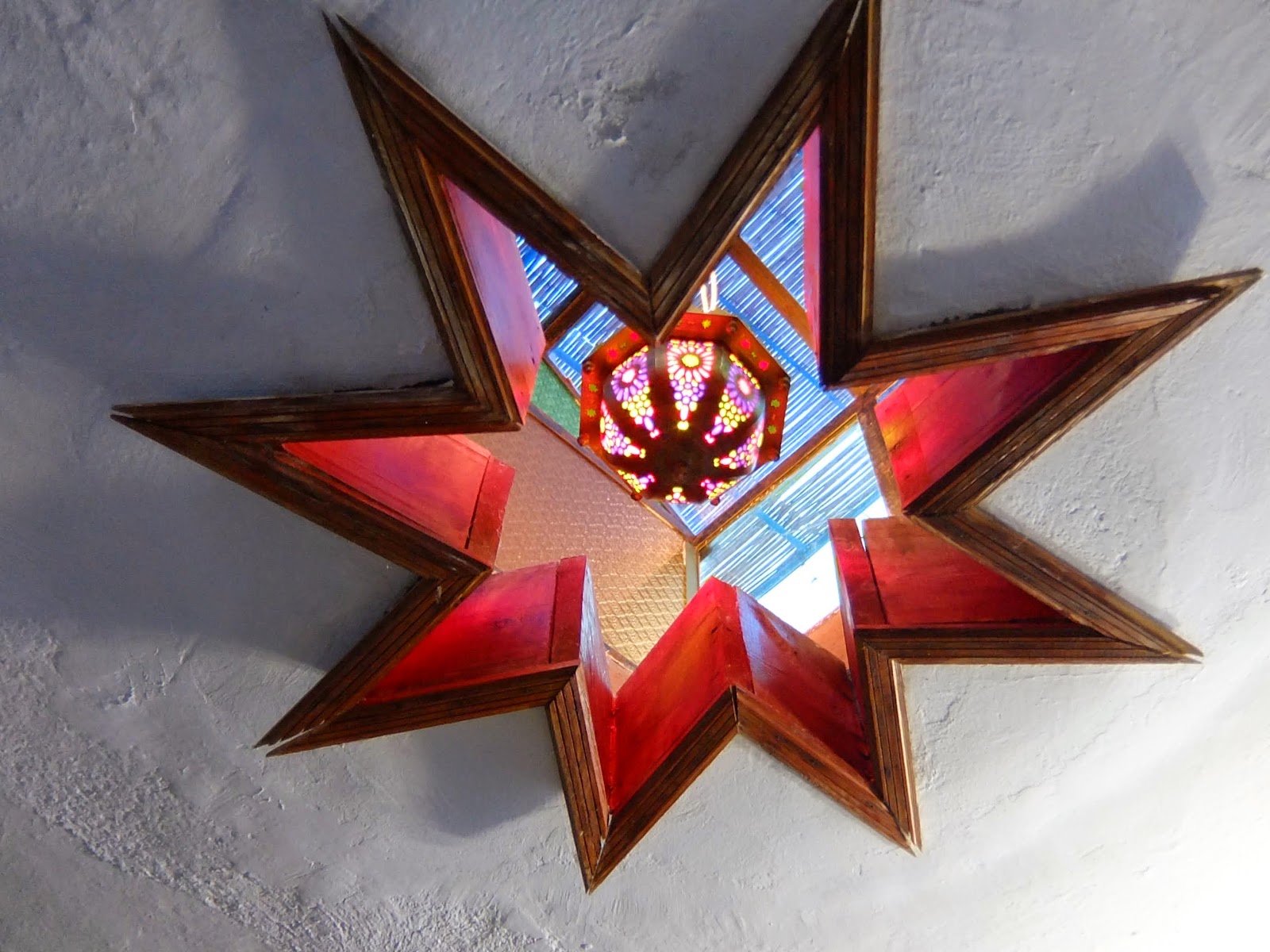
Our window at Casa Elias
The Casa Elias was a nice place, run by quite an active young Moroccan man who speaks excellent English and has quite the entrepreneurial spirit. The housekeeper, who greeted us, didn't speak a lick of English but could speak French and Spanish and was more than happy to try to communicate with us, especially with the phrase, "Chambre o suite?" repeated over and over. Not really knowing the difference, I just kept saying, "Oui, en le internet, je suis Saint Facetious," until she at least just showed us what was either a chambre or a suite and then we agreed on it. The place, though on the fourth floor, looked and felt like a beautifully decorated cave, with even the bed carved of stone or hardened clay or mud that blended into the floor and ceiling. The single window was in the rooftop, shaped like a star, and there was stained glass above that, filtering in colored light to the room below. The bathroom was a bit dank and smelling like a cave, but what could you expect from such a construction? Something told me that everywhere throughout all the hotels was the same. The rooftop, where they serve breakfast, has a really immense view, looking down across the medina. For that rooftop alone - and really, the room was really neat - I would stay there again.

A view from the Casa Elias patio
Chefchouen itself, as I mentioned before, is a blue city. This is by no means an exaggeration. All the tourist manuals are true. The entire medina is painted in various shades of blue - a few buildings got lazy and are stucco white, and there is an occasional red bricked building - usually a landmark, like a castle or a mosque, but one can't be too critical. Most of the streets are wide enough only for one or two people, and one gets the feeling you're in a real fortified city from the medieval days. Apparently, one hundred years ago, it was a green city, and Christians weren't allowed to enter on pain of death. But then the Spanish took the town, forced them to allow Christian tourists, and then the Moroccans - the quick learners that they were - realized that they would be better off taking filthy European and American money from tourists than beheading them. After the Spanish freed up the town, the residents decided green wasn't such a nice color and unanimously decided on blue. I’m not sure what sort of bureaucratic HOA had to head itself over that change of decor, but however  the process went, it was quite successful.    

A street in the medina
We spent the rest of the day exploring the azure labyrinth, going from cafe to cafe, drinking up the hot sweet mint tea and tasteless coffee that are both ubiquitous in Morocco - my advice, stick with the tea. At one place, I enquired about smoking some nargile - a tobacco water pipe.

"No, no, you can't do that hear," he said in a loud whisper. "The police are on about that."

"No, I don't mean hashish, I mean shisha. You know, tobacco."

"Yeah, they've really been on about it. You want to buy some hashish though? I can do that. Maybe come back later tonight and I'll have some for you."

Another street view
Strangely, marijuana seemed to be ludicrously easy to get in Chefchouen, with every waiter and guy walking down the street offering to sell some, though just a common water pipe was impossible to find. I understood that my quest to find a relaxing cafe to chill at and smoke water pipe was over. Later, in Fez, I read an article about how the police had been cracking down on cafes and bars that served shisha, as shisha smoking apparently caused women to become loose and to lose their morals. I facepalmed myself on that one, not realizing why that logic hadn't been so clear before.

In all, we only spent that one night in Chefchouen, though I do wish we could have spent maybe one night more there - though the lack of shisha would have made it daunting to find things to do. Good hiking can be found, and rumor had it there was a big waterfall to see, though hikers are also warned about the large plantations of marijuana out in the hills and along trails. Picking the stuff off farms is frowned upon, and you should probably talk to the guy carrying the machine gun about buying some, rather than risking his wrath.


View from a restaurant

Thursday, March 5, 2015

on the ride, the vomit, and the entitled English girl

At least not during tourist season, it's possible to travel through Morocco without thinking much about the transit options. Trains traverse the countryside, connecting the coastal cities and Fes and Marrakech, while buses are the main mode of transit through the middle country. The buses are either remaining from the heydays of the 1970s extravagance that Morocco probably didn't have, or - and this is more likely - they're hand-me-downs from what was being used in Germany and France in the 1970s. Either way, they're old and they smell old, something like your grandpa's car if he were an aging Mexican migrant worker in California, constantly in-and-out of mythical free-for-illegals healthcare facilities. That is to say, they smell something between moldy bathrooms and a Roman vomitarium. There is one glaring exception and that's the CTM bus line, which sports brand new buses that have restrooms and possibly even wifi. The CTM buses look so nice that when they enter, you can see them shining and glowing, and your heart lifts up thinking that yes! my bus has arrived and it's not one of these dilapidated messes! but no, actually it's a CTM and you didn't book your ticket in time to ride that glossy, shining mother of buses. This is to say that you must absolutely book a CTM bus at least one day in advance - and this is not during tourist season, so maybe even a week in advance during the summer. You can book them online or you can ask your hotel about the most convenient place in town to book them - they often have offices near medinas.

A medina street in Tangier. Not so good for cars.
CTM buses are absolutely the most comfortable, though they might not be on the most convenient of times. The one from Tangier to Chefchouan doesn't leave until 1:00, so we decided to tempt the fates and just show up at the bus station. Getting to the bus station went without much of a problem. We left the hotel and the medina - cars can't fit in any medina really, as some are even difficult for average sized humans to fit shoulder-to-shoulder, imagine that with a brass or lamp vendor crammed in there somehow. From there, we went looking for a taxi and was immediately met by a tout who started pestering us, "The medina is this way, I'll show you. Or maybe you want a restaurant? Or taxi?" This behavior can be cute on an 8 year old, but when the guy is in his twenties, it resembles something more like harassment, but he probably grew up doing this, and took that age barrier for granted.

"No thanks, we'll get our own."

"I'll get you taxi."

And we kept walking away.

"Fuck you!" he shouted after us. Oh hospitality, how I love thee.

In the cities, taxis really are the best form of transit. They cost a bit over double a local bus - which is to say, cheap - and they're not at all confusing. You have the ideal chance for getting lost in the tight concrete and brick canyons of the medina, so don't worry about forfeiting your exploration time either. The bus station is called the "Gare Routiere" in every city, so this also makes things easy.

The bus station in Tangier seemed like it should be a stall out in a small desert village - everything's dry, dusty and worn looking, though still fairly clean - and it's filled with old Moroccan people shuffling around in a design between lost and waiting. The men tend to wear either jeans and jean jacket or a more traditional djellaba, which is a long wool coat with a pointy hood that they usually wear covering their head, so that the waiting areas tend to look like a Jedi Knight convention. The women often wear something similar to the djellaba, though slightly more elaborate and fanciful, and seem to only wear hijab to keep from getting cold - as both groups are keeping their heads covered in winter, it hardly seems something oppressive in Morocco, especially when plenty of women can be seen at cafes and street-sides not covering their head.

We found a bus leaving in thirty minutes, at 10:30, so we opted for that one instead of the CTM - which was probably sold out anyway. The bus wasn't so bad, except for the olfactory festival aforementioned. It took about 3 hours without incident, and dropped us off on a random street in Chefchouan, where we took a taxi to the medina and walked the rest of the way to our guesthouse.

The wife not enjoying waiting at the bus station
When we were leaving Chefchouan, we stopped by the CTM office which was right near one of the lower exits of the medina. Here we discovered that it would have been better to book the day before, so again we had to chance our luck at the bus station. The Chefchouan bus station was quite recently built and had a never-been-used-before fresh-out-of-the-package look and feel. Actually, much of Chefchouan outside of the medina had the same feel, with a surge of construction going on, hotels and apartment blocks alike being built full speed ahead, and everywhere resembling a prosperous vacation town, with even the poor districts looking nice and comfortable, though everything looking slightly empty. Ghost towns freshly built from the dust of nevermore.

We had to wait at the bus station for about one and a half hour and our bus came a half hour after that. Here our luck had run thin. The scheduled three hour ride would turn into six, and all the seats were broken in one manner or the other - recliners permanently reclining, arms swiveling and not locking, holes, mold, broken windows, rude, entitled English ladies, etc. The boy running the bus held his nose in the air, as though he knew the people riding the bus were low class and he was above them - nonethematter he was at their service - but he was friendly enough and loaded on the luggage. When he set a British girl's luggage on the side, she immediately scolded him, "Not that way, turn it over now! Ungggh! No, the other way. No, God, the other way! Unggh! Er!" and then she got on board with all the waddling and flopping of arms of a penguin.

We got on after her and found our seats. The only pair of chairs available were a couple behind hers, so we took them. After about thirty minutes in was when the real fun started to happen. The small child riding with his parents behind us started throwing up, emptying his last three days of food (hopefully) into a bag, though it was possible right onto the floor. I kept imagining vomit flooding across the floor as the bus braked, as though it were the ocean tide rising up, coming in rolls, washing away sandcastles, luggage and boots. And then, an old grandma just ahead of us, started her own gastric warfare. The smell of the autobahn vomitarium nearly became enough to force everyone to join in the action, but at least there was the ceiling window open. Thank God, at least there was that. But the English girl wouldn't have that, and she asked for the nose-lifted attendant to close it.

"You do realize people are vomiting here, yeah?" I asked her, trying to hint to her that maybe closing the only form of ventilation might not be the best idea.

"You do realize my head is about to blow off from the wind. If there are people vomiting here, it's not my problem."

I grunted.

At some city, the bus stopped and she got off. I thanked God and so that we might have control of the window, we switched to her seats - her companion seat was taken by an old lady who had left for good. When the bus was about to roll off, she came back on. Well, there were plenty of other free seats she could take, yeah?

"You are in our seat," she told me. "We only got off for a moment and you took our seat."

"We?" I asked her, looking for the other person. I didn't expect a conversation with a schizoid. But try to keep it civil. "Yeah, well, I didn't know you were coming back and maybe we could switch seats and I could get blown around by the window and you wouldn't have to worry about it."

"I'm not asking for you to switch back," she said, her voice dripping with disdain like a vindaloo drips with sauce. "I'm telling you. It's our seat."

Again with the "our"! And now she's just not being civil, so all thought of mercy dropped off of my radar like a hot air balloon unloading it's weights. "Seriously, it smells terrible here and I need the window open, just please -"

"You are an asshole, you took our seats!"

"Look, when I asked you earlier to open the window because of the vomit, what did you say?" I paused, trying to remember myself. "Ah, you said it wasn't your problem right?"

"I didn't say that to you, I said it to the guy next to me."

"Right, that was me," I said.

"No, it wasn't. I said it to the guy next to me. Get out of our seats! Those are our seats!"

"That was, nevermind. It's not my problem. There are other seats."

"But those are ours!"

"Not my problem," I said. Those words did kind of feel nice. They were a kind of release from the world of sweat and vomit and whatever else was going on in that carnival of vile smell.

"You are a real ass hole, you know that?"

"Not my problem." Yes, this was getting fun. One more time, please!


She huffed and puffed and luckily I was not sitting in a straw house for her to blow in, since the fuss she was making clearly was so that I would give some damn that I didn't. Then she gave up and sat in the empty seats directly behind us, so that she could glare at me for the rest of the entire trip. Whatever, three hours of glaring, I could deal with that, as long as I had that cool, brisk wind stroking my face, keeping out all those nasty little smell molecules from my nose.