Showing posts with label touristic sites. Show all posts

Monday, March 30, 2015

the worse the smell, the closer you are


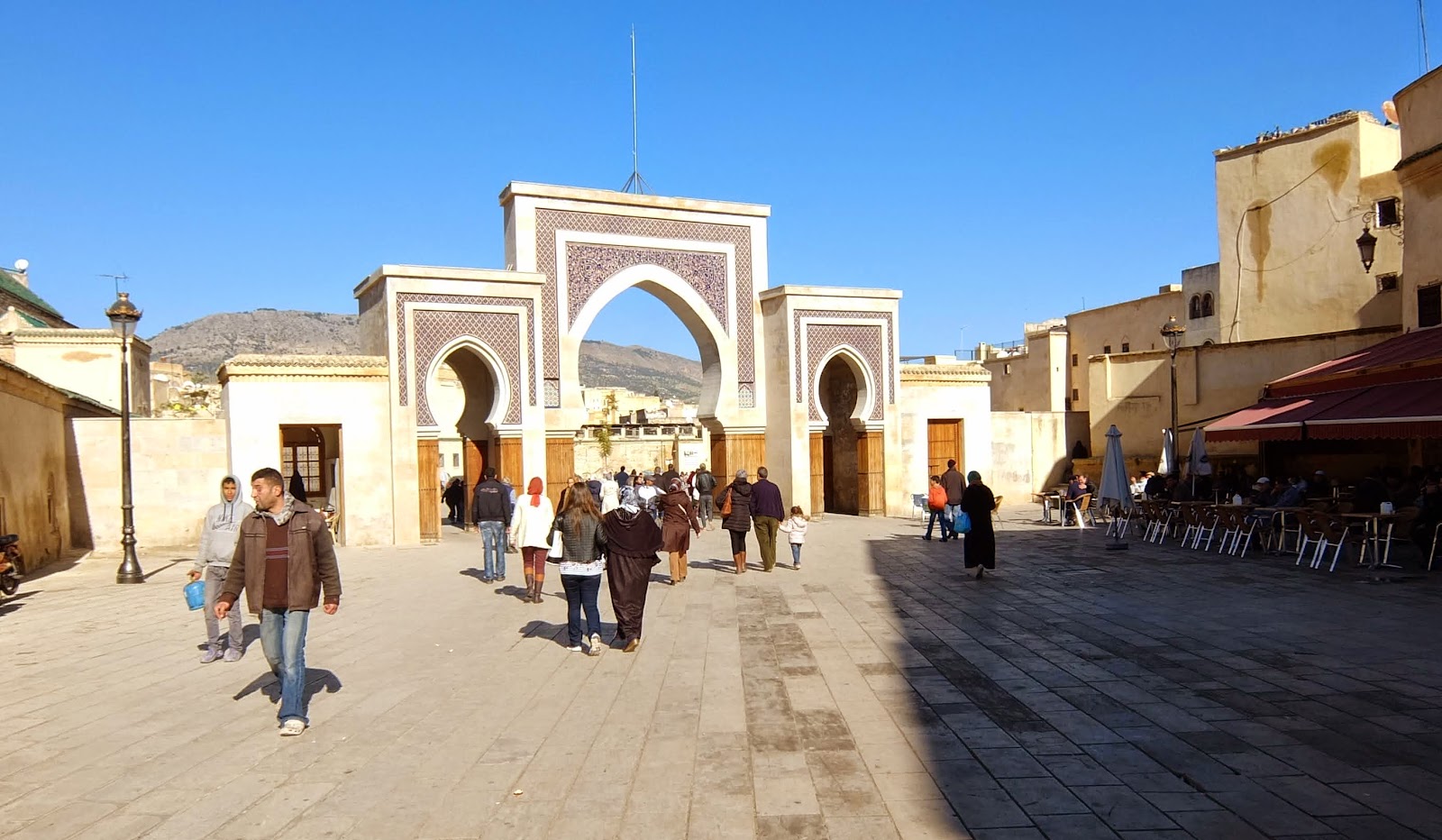
The Rcif square and gate to the medina
I'm still not overly sure on the dining options in Fez. At night, the medina is quite intimidating - the narrow walls of the streets magnify the mystery and horror - and the shrill screaming of random crazy people certainly add some kind of element that can't necessarily be described as comforting. This, of course, makes the offers of the various restaurants and hotels for a night custodian quite comforting, since if you're out too late, you can always just have the cafe or restaurant you're in give a call to your hotel. Though our Riad had this service, and we used him New Years night, he didn't really seem eager for tips, so one didn't have to worry about that - he just dropped us off and quickly disappeared. We did make sure to tip him at the end of our trip, as the same guy was all sorts of helpful in arranging things during our stay. 

The Ruined Garden
We did find one cafe that had great food and an excellent outdoor garden for eating, kind of an oasis in the alleys. It was called the Ruined Garden. The service was exceptionally slow, but then we were there on New Years Day, so that could have had an effect, as the staff must have been up all night cleaning up. The food and juices were excellent though - and by the way, drink juice in Morocco. Always fresh and always cheap. The atmosphere in the Ruined Garden can't be beat, with greenery sprouting out of every crook and cranny in what appears to be ancient ruins behind high stone walls.

I mentioned before that recently in Morocco, there had been a movement to discourage young women from the lascivious activity of shisha smoking, so shisha bars had become absurdly and un-stereotypically harder to find, even in such a large city as Fez. Queries to the hotel staff were left in ignorance and simply an offer to use the house water pipe. The waitress at the Ruined Garden had tipped us off to one place, the Fez Lounge, which was "Right down the Talaa Kebira." Well, despite going right down the Talaa Kebira, or possibly it was the Talaa Segira or the Zkak Roua - really, they all look like the same windy narrow alleys with occasional hints of sacred glamor from tiled towers and minarets - we couldn't find the Fez Lounge. My next object was to find a hookah water pipe souvenir, but besides some crappy ones clearly imported from Egypt, there didn't seem to be much of those on sale.

A main street in Fez
If you're going to Fez though for bars, indeed, if you're going to Morocco for bars, you'll be sadly disappointed - and you'll have had quite eccentric expectations for a Muslim country. Indeed, the real activities you'd go for in Fez have more to do with wandering around the medieval medina, making your way through the bustling crowds of students and merchants, tanners and lamp makers. The medina seems impossibly busy - mainly because the amazingly narrow streets are the only thoroughfares - but eventually one can cope with it, understanding that there are basically two main avenues, and everything else sprouts out from those two main avenues. Once people start becoming sparse, it probably means you're heading into somewhere you probably shouldn't, and the feeling that the sudden stark emptiness brings to you is of a dark foreboding that possibly you should follow, especially as some hijabbed lady comes out at you and tells you to go back now and that the main street is that way, not this way, especially not this way, don't ever go this way.

Those two main avenues are filled with trinket and souvenir sellers, who aren't overly pushy. Occasionally children tried to lead our way, and we let one guide us back to Rcif, mainly because he was a cute little guy and made fun of my beard. They're not being cute or helpful for free, but for small tips, so understand that. There is little kindness for outsiders there that doesn't involve tips.

Drying and dying some leather
The main touristic draw - also being, strangely, the main thing that the local goverment isn't aware of being a touristic draw - are the tanneries. That's why people go to Fez. The government keeps talking about moving the tanneries outside of the medina, somewhere far from town, since the smell is a bit overwhelming - to cure leather, one needs to dip the skin in piss and poop, both things not of what most would describe as having pleasant smells. Despite this though, it would be an absurd mistake to move the ancient tanneries, since that's the main thing to see. Tourists certainly aren't coming to see the oldest Islamic university in the world, indeed, possibly the oldest university period in the world - because non-Muslims aren't let in there, and even when you're just on the outside of it, you'd never know you were since the walls and avenues, to the untrained eye of the visitor, all look the same. Or at least they vary enough to make everything seem an undefined blur.

A cat helping dry some leather
The tanneries though are well marked on Google maps, and if you don't have a smart phone, you can just let your nose be the guide. The worse the smell, the closer you are. As you start wandering down random side alleys, trying to find the famous view, guys will jump out and "sell" you a tour. I'm not sure if you really need to pay them, but since it's a fairly no hassle five euros, and the guy will take you to the best views of the stink pits quite quickly and will throw in a mint sprig or a cubed thing of smell good, it might be worth it. The trip though is characteristically topped off with a visit to a rug shop, where they try to sell you high quality rugs for fairly low prices. Not low enough for us, but if we were in the market for rugs, perhaps we would have bought some there.

A loom in a rug shop
The rug vendors were characters though. "We have these massed produced boring ones, they are cheaper and quickly made. Made by men, traditionally. And the much nicer, more beautiful, and more expensive ones are made by women. The women have more time to make the rugs, and are working all day long on them, and one rug will generally take a woman two or three weeks to make." We looked at some, and asked the price for a couple, but at 300 euro, they were still over our heads.

"Name your price then," the vendor said.

"We've got a hundred to spare, and I like that one."

"No, you must be reasonable. Name a reasonable price. That one is 300."

"But that's the price I'll pay, because that's what I have. 100 euro."

"That's not a reasonable price, name a reasonable one." He apparently had never seen the walk away tactic actually being used, since that was what we did. It worked for me lots in buying weird textiles I didn't really need in Turkey, but here I was saved my 100 euro by his steadfastness.

"Really man, that's all I can do, have a nice day!" And we walked away.

Monday, February 23, 2015

things to do in Tangier

We needed some more cash. The place at the airport was a complete rip off - one stand that is a chain at most airports. You typically lose about 40 percent of the value of the money using their rates, and only after arguing will they knock it down a bit. Best to always carry a converter with you and know how much your converting and how much it should be. The exchange will naturally be a bit off the published rate - that's how exchanges make money - but they should be reasonably close to that rate. We found a place near La Petit Socco, or "the small bazaar" in French, that offered an almost exact exchange rate, something that for me is a rare occurrence, but seems more common in Arabic countries - beware Spain and the Czech Republic, countries that can be overly sneaky on their exchange rates.

Going from euro to dirham, you end up with a gigantic wad of cash, feeling like a rich man ready to throw money into the wind. It's a great feeling, but soon it becomes annoying when you realize it means all your pockets, secret pouches, and wallet will be left bulging for the rest of the trip. A small price to pay for wealth.

Les Files du Detroit
We then found the Kasbah, through the diligent use of my smartphone. Only for one hour was my Google maps application a bit confused, but finally it was able to guide us correctly to our destination. The entrance to the museum was three dirham, or thirty cents, and the smallest we had was twenty. The attendant refused to allow us entry, claiming that he didn't have change. So we looked around for a tea shop to sit and have some tea and thus get some change. There we found the pinnacle place of Tangier, Les Files du Detroit, or "the Sons of the Straight." It's quite a small place, one long room, that's quite ethnically decked out with pillows and beautifully carved woodwork. Instruments hang everywhere from the walls, and a small man was sitting on a pillowed bench, wearing a Fez and playing a Moroccan lyre, singing some song that sort of resembled Arabic music and sort of resembled jazz. When he finished, he stood and offered us some tea and showed us his record, which we bought (and is great). After serving us tea, he had us do some silly touristic posing underneath his instruments wearing some more red felt Fez hats, but then relaxed again into his singing meditation. After we were done, I told him about our problem with the museum, and he took us over and got us in without a problem.

I later found out that musicians often gather at Les Files du Detroit at night. As we were only there for one more night, and were still a bit weary of the medina - it truly feels like an altogether alien culture - we didn't manage to make it out to see any jam sessions. So, to any traveler there, find it at night and be sure to toke on some local herb while listening to some live jams - or join in, there's plenty of instruments lying about.

Some guys playing a tune at Le Files du Detroit:


Inside the Kasbah
The Kasbah is a bit of a ruin and not much of a museum, but you can at least see the main courtyards and hallways, and imagine how beautiful it once was during the days of the sultans. The woodwork and the tile work - more of which seemed to be the standard throughout Morocco - were stellar in their complexity and skill. The palace was a good introduction to this, seeing everything in place and style as it was meant to be. From the Kasbah, there's also a nice view of the bay, where one can imagine the sultan and family drinking tea and looking out across the sea, preparing to purvey the rest of his empire in Spain, or perhaps dream about that lost empire, depending on the century.

Some of the ceiling woodwork 

One of the inner courtyard gardens.

Ceiling tile work and a typical lamp

The palace minaret

From there, we went on to the American Legation. As I mentioned before, it was an early gift of the Moroccan kingdom to the United States of America, and is today the only American government owned historical landmark outside of the U.S. Morocco was one of the first countries to recognize the Declaration of Independence and give good favor to the newborn republic. At this period, Morocco had just finished a long civil war, with the new sultan eager to gain economic wealth through trade, and sought out a positive relationship with the United States even before the War of Independence was won. In 1821, the Sultan Moulay Suliman gave a two story building, decorated in traditional Moorish style, to the American government, where it was used as an embassy, consulate, and finally, Peace Corps office, for 140 years. Now it's a museum, showing this long history, including a wing dedicated to Paul Bowles, the beat writer who lived in Tangier, and all the other beats who had visited.

The building itself is snuggled in a very residential corner of the medina and it's easy to think you're going the wrong way while you're en route there, which is precisely what happened to us. I was quite convinced we had taken a wrong turn, or the guy at the cafe over on La Petit Socco had misguided us - remember, it's always best to ask someone busy doing something else for directions, otherwise they'll tag along and expect a tip - but finally, we saw the small sign hanging off a wall in the street. The streets in this part are narrow, so it's perhaps better to call all of them alleys, but around any bend can be something unseen and beautiful, palatial courtyards hidden away like the hair and body of a devout Muslim woman - pleasures for only the few.

The museum is definitely worth the find. Whereas the Kasbah is a great example of a dust covered, ruined architectural wonder, the Legation is kept up so that it looks exactly the way it would have looked a hundred years ago. The very same tables that those from Thomas Jefferson to Paul Bowles would have sat at in a meeting or an exhibition, all there, polished and shining, the same as they ever were, the woodwork and tile work all exhibited in a remarkable level of historic preservation. If only there were a cafe out on the patio, it would be the perfect place to spend a whole day writing and watching the people pass along the alleys below. But lacking such a cafe, touring about the place takes up all but 20 minutes.


The courtyard of the Legation

Looking down at an alley from a bridge

Inside the Paul Bowles Wing

Some more tile and wood work

With so much time left over, we decided to leave the medina and see what Tangier was really about. Which wasn't much. Along the waterfront were weirdly glitzy hotels, the kind I've seen all over seaside towns in developing countries, where they were superficially fancy, as though they were fancy only to those who didn't really know what a fancy hotel was. Up the hill, there's a run down terrace, called the "Tanger Boulevard", filled with cafes that are also a bit run down, but have a beautiful view of the Straight and of the medina. Near there is the Tangerine, where the beatniks once hung out. Since then, it's been a gay club and now a somewhat seedy place that seems surrounded by a trash dump and dark eyed men staring at anyone who would pass the place. There is a nice boulevard above that, Avenue Pasteur, with several modern cafes that are good places to drink coffee and watch people, but are lacking any real character. The first we sat at was called "La Espanola", and was complete with a large mirror and the cafe's name spelled out in rhinestones. Rhinestones always spell class. 

Touring these coffee shops was pleasant, but satisfied enough of my curiosity about what Tangerines did in the evening. In all, it was neither a horror story or a fantasy, just a fairly normal Arabic town with some beautiful views. And at any rate, Tangiers from a view is an extraordinarily beautiful town. It's only when you're actually in the White City that it doesn't quite live up to the senses. It's probably best then to stay in the medina and sit at Le Petit Socco, drinking the sweet mint tea and letting the day pass away to the hum and bustle of tourists fresh off the boat and hustlers looking for an easy pay day. Or with a few extra days, to make some trips out of town to the villages that dot the coast.

Sour Meegazine Square

View from Sour Meegazine

View from Tanger Boulevard


Down Rue de Murillo

Tuesday, February 10, 2015

touts, thy days are numbered

View of the medina from our the Hotel Continental
I had mixed impressions of Tangier before we arrived, not really knowing what to expect. On the one hand, it was the Interzone, the safe haven for past beatniks to hide and get high, full of drugs and gambling and prostitution, but on the other hand, it had had stable rule for years now, and the King had recently infused large amounts of cash into the economy to help fix things. I had an image of the former burned in my mind, of a crumbling medina full of dirty street beggars, snake charmers in small squares distracting people while they were as charmed as the snakes while boys in rags pilfered the contents of tourists' pockets. Travel sites with reviews by travelers from the States and Europe are overwhelmingly negative on the city, saying that it was the worst in Morocco and that touts - guys who make it their business to lead you places and then charge you money - abound and everyone is trying to scam you. So it's with this mentality we entered, and one might ask, why on Earth would I go to a place if that was my preconception of it? But then I would answer back, why wouldn't I, sounds amazing!

Interior of the Hotel Continental
We were staying at the Hotel Continental, which itself is like a museum of architecture. It sits on an overlook of the bay, where you can sip your morning coffee on the balcony, looking across the Tangerine resorts and apartments stacked along the shore and watch the huge cruise ships sitting at wait, unloading or loading passengers into rows of buses and taxis. The breakfast was more than expected - a continental breakfast, but also with fresh pancakes, jam and lots of tangerines - hence the name of the fruit.

After breakfast, we went out to explore the medina. I had three goals in mind - to relax at some coffee shops and soak it all in, to see the Kasbah and the American Legation museums, and maybe perhaps to see a place where the American beatniks had hung out, like the Tangerine Bar, the walls of which are now adorned with the pictures of the famous writers who had once imbibed and found their pleasures there. It would have been nice to see some of the nearby villages and the Hercules Caves - said to be the place where Hercules rested from his travels upon reaching the pillars - but one can't see too much. If you see it all then you have nothing left for mystery and all is left for disappointment.

City street in the medina
The medina itself was beyond my expectation. It was the medieval center of town, buildings crammed together and surrounded by a wall, exactly how European towns had been before the days of the more established empires of Napoleon and the Hapsburgs, when they started clearing out ghettos and creating wide boulevards. Though it was much cleaner than I thought it would be. All the walks were paved and there were few pieces of trash in sight. In fact, the lack of trash throughout the Moroccan cities were a constant thing of wonder to me, given how crowded the living conditions in the medinas were and hence the impossibility of a decent sanitation system. But the locals were constantly cleaning - sweeping, gathering trash, etc. so that things wouldn't pile up - habits that themselves piled up over thousands of years. I can't imagine how things could be carried out, sense the medina tends only to be accessible by car through one road, and that one tightly so - vendors, shoppers, tourists, residents, holy men, and merchants all scrabbling out of the way when an automotive passes.

For the most part, we were left at ease while browsing through goods in various shops. Mostly, you can buy lamps, light covers, stained glass goods, tea and coffee pots, traditional clothes, and traditional shoes. And for the most part, outside of the younger generation who tend to wear blue jeans and white shirts, most Moroccans are still wearing their traditional garbs, which look something like what Jedis from Star Wars would wear, long robes with pointy hoods. The shopkeeper would come to us and stay a respectable distance, which was normal. None of the hassle that I had read about. We were only approached once by a tout, who kept insisting that he could take us to a square - which we had already visited and knew the way to. As we walked past him, he followed us and kept acting as though he were giving us a service.


Le Petit Socco, the main square of the medina
"La shukron," I kept repeating. "No thanks," in Arabic, in response to his constant offers of assistance to show us the way. Part of the magic of the medina is to get lost, and really, the Tangier medina isn't so huge to get terribly lost in. It's a perfect introduction to medina life if one is headed to Fez or Marrakech, both much more maddening and hectic. But with the modern smartphone and GPS, the tout's days are numbered even with the most ignorant of tourists.

With enough persistence, however, the tout caught my eyes. "Why are you so paranoid, man?" he said. 

"With reason, now excuse us."

Monday, February 2, 2015

the choices of travel

It was tough choosing places to go in Morocco. There is a great deal of cities that are of interest to both the wife and I, but I knew from traveling that you have to appreciate your time limitations. It's better to see one or two places well than to see fifteen places in a rush. You have to miss some things and at the end of the day, you have to realize that that’s okay. Maybe you’ll come back, maybe you won’t, but at least you can have a great and relaxed time of seeing some of the sights. To implement this, before we left, the wife and I sat down and wrote out a list of our top spots in Morocco and we shared that with each other. Then we looked at travel options - trains, planes, and automobiles - and did the best we could to respect each other’s wishes. It’s always best to add in the ideas of your partner, since there can always be something amazing that you could have never thought of, and likely your own ideas might end up stale and wanting.

The cities and things that made it to our list:

Marrakech (the wife’s list). It's the most well known of the Imperial Cities - or former capitals - of Morocco. It's also the most touristic and cleaned up, an attempt to give a bright, shiny, and happy view of an otherwise impoverished nation. That said, to see the best examples of the highlights of Moroccan culture, this is probably the city to see, with a cleaned up medina - or old town - and lots of hotels with preserved and interesting architectural flourishes.

Marrakech, credit to: www.corendon.com

Fes (the wife’s list). Not to be confused with the funny Turkish hat - though some people do wear the hat in Morocco, namely people involved some way in tourism. It's the other well known Imperial City and famous for its giant leather factory, where most of the handmade leather you find sold in European city streets comes from. Some people say it's also what Marrakech looked like before the hotel and tourism boom, and that there are still actual people living in the medina, which is also the largest in the Arab world, and can also claim to be the largest carless urban area in the world - the place though is quickly gentrifying, as many of those people are forced out by hotel developers and many prefer better living conditions that can be more easily afforded in the newer parts of the city. It's also known as the Mecca of the West and has one of the oldest Islamic religious schools.

A view of Fes from our hotel
Chefchouan, the Blue Pearl (my list and the wife’s list). It's a small mountain town where all the buildings are painted blue. They used to be painted green back when it was forbidden for Christians to enter the city on pain of death - at that time only Muslims and Jews were allowed to enter. But then the Spanish came and ended that practice, so for some mysterious reason, the locals changed the paint to blue.

A view of Chefchouan from a restaurant in the main square

Meknes (my list). Another one of the Imperial Cities, though one of the smallest. It's only got a mere 1 million citizens living in the city - but not in the medina, which is truly the smallest of the Imperial Cities in Morocco. The medina is supposed to be more charming and friendly than those of Fes and Marrakech, with the people of the markets not so pushy. Nearby is the ancient Roman settlement of Volubilis, which is open to the public for touring. This was one of the top sights on my list for that reason, as I’m somewhat addicted to seeing ancient Roman cities. The other top sight being...

Volubilis. Photo credit: tripadvisor.com

Tangier (my list). My wife had absolutely no interest in Tangier, but I was drawn to it, because of its deep connection with American history. For one, Morocco was one of the first nations of the world to recognize American independence, and even donated a palace to the American government for use as an embassy. The palace - known as the American Legation - is the only U.S. historical landmark located outside the United States. It's now a museum, dedicated to the long history - in American eyes, quite short history in Moroccan eyes - of friendship between the two countries. Tangier was also where most of the beatniks decided to locate themselves. During the mid 20th century, it was called the Interzone and was a kind of lawless, free territory outside of any legal jurisdiction. This meant that drugs, prostitution, gambling and any other number of fun stuff was going on, and so it was a natural draw for the beats, pulling in such residents as Paul Bowles - who would spend the rest of his life there - William Burroughs, Jack Kerouac, Tennessee Williams, Alan Ginsberg, among others. The city is also one of the oldest cities on the Mediterranean, being first founded by the Phoenicians - and there was probably a Berber settlement there before that - even before Rome's first foundation stone had been lain.

A view of the Tangier medina
Essouiara (my list). Orson Welles shot his "Othello" in the town, making the Moor of Venice authentically Moorish. It's among the oldest cities in Morocco, having also been founded by the Phoenicians long before the Phoenicians had even started writing things down and distributing alphabetical systems to the people's of the world. It later served as the main harbor town for Marrakech, and there's reportedly nice beaches, medina and castle there. Ruled off the list since it seemed better to visit when not in winter.

Daenarys looking down at the slave city of Essouiara
The Sahara Desert (the wife’s list). This is mostly in the south of Morocco, as the north is filled by the Rim Mountains and coastlines. There are lots of Sahara tours available from Marrakech and Fes where you can go play as a camel jockey for a couple of days or a week. Most tours are several days or more long, and a day trip really is only practical from Marrakech. Some parts of the desert are still dangerous due to banditry and the currently unresolved issue of the Western Sahara, though for the most part it's probably safe.

The Sahara of Morocco, photocredit: www.atlastrekshop.com
Those were our choices. The next step was to figure out how to get to Morocco, and let that decide where we would go from there. The cheapest flights from Prague to Morocco that I could find were on Vueling airlines with a stopover in Barcelona. I extended the stay in Barcelona - a city both of us wanted to visit - and bought tickets for the different legs, actually making the flight prices even cheaper, though not by much. The cheapest flights to Morocco were also from Vueling and went from Barcelona to Tangier, and from Fes to Barcelona. With one week to spend, that pretty much sealed our choice. We would arrive in Tangier, take the bus to Chefchouan, another bus to Fes, hopefully spend a day to see Volubilis and then make it back to Barcelona. We'd have to leave the rest for another visit, if Morocco deemed worthy of another visit.

But as we left the airport in Tangier, leaving that smiling customs official who nearly refused us entry based on their own error of not knowing how to read a passport, and how the taxi drivers had upped the price, and on my own experience with Arabs in Egypt trying to rip me off at every turn, I was beginning to wonder how this trip would round up. I'll prelude my review of Morocco with this: we will definitely return. And next week, I'll go over Tangier.