Showing posts with label hotels. Show all posts

Monday, March 23, 2015

an authentic tourist experience

Fez from our Riad rooftop
We spent our New Year's in Fez. For the backpack traveler in me, I would have preferred to have found a place on couchsurfing and celebrated it with a local or an expat local, someone who at least would have had more knowledge of where to go than we did. But the newly wed in me wanted the privacy that a hotel could afford, and wanted to spend more time with my new wife rather than getting to know other strangers on some superficial level. This is primarily why we opted for staying at hotels on this trip, over couchsurfing or Airbnb - getting both privacy and convenience - and why we chose to go ahead and do the Riad's plans for New Year's.

While we were on the bus, more specifically, while we were stopped and I was using the restroom, I got a call from the hotel manager. As usual, as I jostled my phone out of my pocket, I kept imagining it falling down into the hole and having to swim after the thing. But thankfully, years of practice balancing possessions in farmyard lavatories kept the phone dry. The hotel was organizing an event for the night and wanted to know if we wanted to attend and that if we needed any help getting to the Riad. Having read extensively about the Riad la Maison Verte online, I knew they could be a bit overprotective of their guests - smart business, because you can corner them with your services and make more money with the less travel savvy guests - so I told them I'd get back to them about the dinner but wouldn't need help getting there. She was, after all, calling me while I was standing around a fly infested hole in the ground on break from a moving mass ambulance of sick and dying people. Luckily, I had left the wife back on the bus to guard our seat so we could ensure the one window of the bus would stay open and not suffocate us. There were dark forces on that bus and it took all our effort to keep that window well ajar, to be rid of those fecund spells. 

The Mrs. and half of the starter salads
We opted for the dinner. It was held in the sister Riad, the Palais de Fes dar Tazi, a massive palace overlooking the Amal Cinema square. The palace is stunning, the architecture inside is grand by no overstatement. It's worth just a walk through the Riad to imagine what a real Moroccan palace looked like - possibly better than any museum could show. A walk through can be done by visiting the restaurant up on the rooftop. The menu is a fixed price deal and it seems expensive at first, but understand that the small dinner is enough for two or three people and every dish is melting in your mouth good. Also, there's live Moroccan musicians and an amazing nighttime view of Fez. 

The said restaurant catered the event, and the food - including carrot salad with vanilla, eggplants and caviar, and the most exquisite pigeon pot pie - giving me a new respect for pigeons - was so phenomenal that we decided to go to dinner at the restaurant again the next night, passing on finding something new and different simply to relive the succulent bacchanal of awesome tastes that was happening in our mouths. 

The main feast hall cieling
Hotel events can range on the cheezy side to the ostentatious side, with every side in-between, and always a bit overpriced. Being at the Palais de Fes, it did stray on the ostentatious side. We had the option of a "private" or "public" table, and since knowing that meeting some randoms might be a bit more entertaining, we went for the public table, where we were seated with 8 other people, mostly from various parts of Spain. This meant, outside of a few courtesies, we were left mostly to ourselves, since most of the table chatter was in Spanish and the Spaniards' command of English wasn't much better than my command of Spanish.

Guys banging on drums
At the center of the hall's attention was a band playing some traditional Moroccan music, with an occasional variance in entertainment - at one point some yelling guys in white outfits banging on drums came in, waving their drums about in manners that were either traditional dances or making fun of the guests - "I get 20 dollars for waving around drums and shouting at silly white Europeans? Okay." But, you know, what might seem sometimes absurd to the local seems like an authentic cultural experience to the tourist, so fair game. There was also a belly dancer there to perform - another thing that's not overly common in the Middle East these days. I remember reading about an English woman moving to Beirut, she was looking for a job and found one teaching the lost Middle Eastern art form to the locals!

Authentic belly dancing!
The night went on mostly like that, though at one point, the girls running the hotel kept trying to pull up everyone to dance and have fun. Moroccan dancing seemed something like Turkish dancing, where they just wave their hands in the air and step back and forth, occasionally linking for a circle where you just kick in random directions like your tossing out some evil spirit at a Quaker fest. But it was fun, and the effort itself was dear, since it was clear that the girls themselves just wanted to enjoy their night while having to work. And that said, it was somewhat surprising to see in a Muslim country, girls without hijab happily leading dances with strangers. And it was somewhat a bit backwards than what I was used to, since in Georgia it's nearly always the men leading the entertainment.

The night ended with the dancing and the music, and in all, both of us were glad for the experience. It was fun, weird, and gave us a sense of "traditional Moroccan culture" enjoyed by rich Moroccans of the past. It was worth the 50 euros each, even though it didn't include wine. Scratch that, it would have been worth it if it had included wine! Sober on New Years, unheard of!


Wednesday, March 18, 2015

the riads of Fez

View of Fez from our riad
Fez was a bit more intimidating a city than Chefchouen or Tangier, and after the little bus ride of horrors, it was much more tiresome to confront. We wanted to just get to the hotel as fast as we could, preferably without the penguin-waddling, angry British girl that ruined our vomatarium bus-ride of fun. The bus seemed to circle around the white-walled medina of Fez an innumerable amount of times - or at least that's what it seemed like with the walls making endless eddies inwards and outwards, unidentifiable for lack of features and gates. This was something new and incredible. On the medinas we had visited previously, the city was on both sides of the wall, having long since out-grown their artificial barriers. But with Fez, the city was well contained, partly  because of the creeks and cliffs that surrounded the old town and partly because the “new town” was quite in a separate geographical place.
That said, when we stepped out of the bus, we opted to head straight for the first taxi that wasn't chasing us with shouts of "Hey tourist!" Dodging that immediate squadron, I was able to hail a taxi in the parking lot. As I stumbled around with my very limited French the guy stared at me and then drove off. No luck there. The second guy I was able to talk to agreed to take us close enough to our hotel - being in the medina, taxis can only really take you to two main squares and you're on your own with GPS and Google maps from there. He agreed to take us for 20 dirham, which is about 2 euro. Even less than I had been willing to offer, and was less than what would have been my offer - it’s my rule to let the taxi drivers set the anchor price. I decided it best not to argue with already favorable terms. I gave him the difference as a tip, since it's always a refreshingly rare thing to deal with a nice guy in a cab.
Cinema Amal gardens and the Palais de Fes riad and restaurant (great restaurant!)
He took us all the way to the plaza with the Cinema Amal. I'm not actually sure what the place is called, since Google maps isn't overly clear on the issue. It seems as though, when labeling the medina, they trusted in tossing darts blindfolded at a map on the wall. Unfortunately, Google maps is not so open source, or I'd just go in and fix the more glaring mistakes there are, but as Obama once put it, "That's above my pay grade." As it is, the taxi driver took me to a place where we agreed could have been either Rcif plaza or where the Cinema Amal is "just over there". My GPS though was right on with La Riad Maison Verte, which was our destination. We grabbed our bags and dove straight into the alleys and tunnels that so define the Moroccan medinas, using the cell phone GPS as a kind of ball of string in case we disturbed a minotaur. Finally, we were able to get the Riad in the general area of the blue circle on my Google maps, then relied on some signs that were occasionally stapled to this corner or that, and then we successfully passed the unmarked wooden door twice, until I realized, "Ah, that's a really nice door and it's close enough to the signage, yeah?" When you're walking down the alley though, it does not look like an entrance to the nice hotel that it is, it just looks like a door to possibly someone's house, or possibly a camel market, or factory, or who knows what the hell is behind any of those doors in those bare walls of the dirt encrusted Fez medina. And therein lies what is awesome about Fez. (note: the plaza with the gardens is what's referred to as the "Cinema Amal", and if you tell a taxi driver that, that's where he'll take you.)
The courtyard of the Riad de Maison Verte
The entrance of the Riad takes you into the courtyard, a beautifully tiled shaft to the sky above, around which the rooms look down into the courtyard. There are various doors and passageways that lead up to the rooms - there are two rooms on the groundfloor that don't provide much privacy, as the windows open up to the courtyard seating area. The rooms are all fairly small - we thought ours was a hallway, until the placement of the bed made us fully understand that that, actually, was the whole room. But it was also immaculately decorated, with intricate tilework and wood carving throughout. One can easily imagine being from earlier times and seeing this as a place where minor nobility and upper class merchants might have stayed during their presence in Fez.
The rooftop of the Riad
A "riad" though, wasn't traditionally an inn - though it could have been. It was traditionally a house or a palace, with the courtyard serving as a focal point - hence the term "riad", which is Arabic for garden. The Moroccans started this style of house as an inheritance from the Roman days, with the ruins at Volubilis showing some fine examples of the ancient system. Many cultures today preserve the style too, from Romania, to Georgia, and - though I haven't been - probably in Italy, often bearing the term "Italian garden" or "Italian yard." The style leads to the surreal street design, where the windows are lacking on the lower outer walls, which allows for tighter streets without a loss of privacy. And privacy, is probably the number one factor in sustaining the style, in that Islamic culture holds it at a huge value. With a truly private place, and with a nice interior garden, the women can disrobe and relax without having to worry about the conventions of modesty and manner that she must worry about outside. Many of the riads of old have since been restored and made into hotels, so keep in mind that it's something akin to having a room in a house. Whereas the family's privacy is certainly kept, the individual's privacy might not be so much. That in mind, I would still suggest choosing a riad to stay in while traveling in Morocco, to truly get a sense of how the ancient Moroccans fared and lived, and to get a taste of authentic Moroccan architecture and style.

Monday, March 9, 2015

the blue pearl

The bus took a windy road through the Riff Mountains to Chefchouen. The mountains there weren't huge, but there was a beauty hanging from their sheer brown cliffs. We entered the suburbs of town, looking out the windows in some dismay. There is no majestic entry to the city, as the road first hits several outlying villages. The houses are nice - they weren't slums that we passed through - but neither were they the idea of the beautiful, isolated touristic setting that we had originally imagined. At first, we thought the small towns near Chefchouen were supposed to be the place itself; let down, thinking, "I thought it was supposed to be all blue." But then, around one bend, we finally saw the city. The blue part, the part of town that gave it the name "The Blue Pearl", is bedded between two mountains, making it seem as though it's isolated from civilization, though in actuality it's surrounded by small, growing and modern towns. The modern town of Chefchouen - where the bus dropped us - seemed to be a construction project, and a new tourism booth was set up right on the main road. We had asked the guy there about the bus on the following day and he let us know that that was the first day the tourism booth had been opened, so he was quite excited to give us advice. The advice is that the CMT bus tickets are sold right up the street towards the medina, and to buy them in advance, because they sell out quickly, as per my last post. 

Place Outa El Hamam at night
From where the bus let us out, we found a taxi and took it to the main square in the medina, Place Outa El Hamam, a fairly romantic square with one side taken by a steep walled fortress and the other sides by outdoor cafes, chairs and umbrellas spilling over the cobbled plaza. From there we had to make our way through the initial blue bends and turns - everything blue, as though there were an effects switch to tint everything blue in your eyes - and finally up to the Casa Elias. With even that just short walk, we were already excited to see the city

Our window at Casa Elias
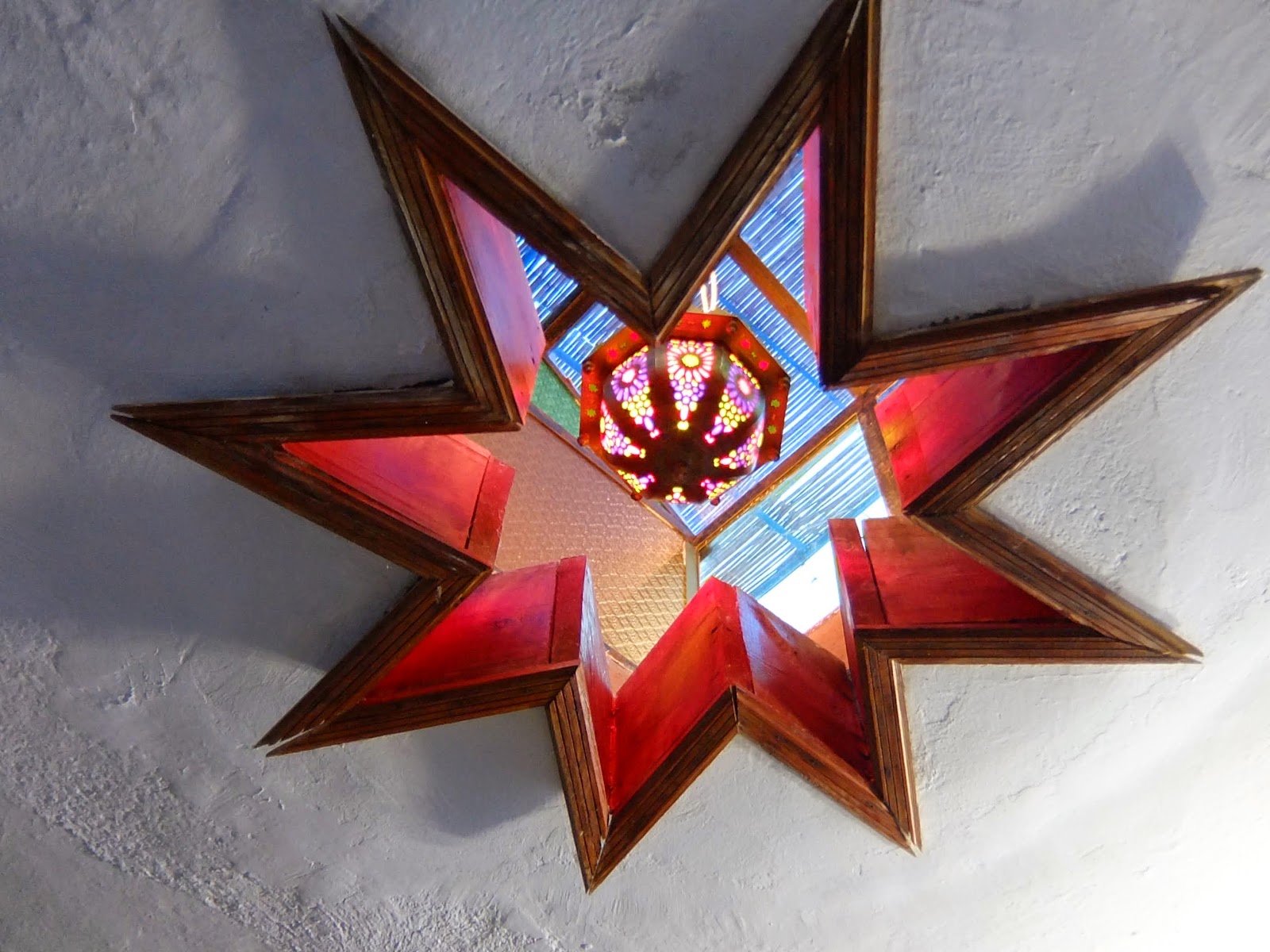
The Casa Elias was a nice place, run by quite an active young Moroccan man who speaks excellent English and has quite the entrepreneurial spirit. The housekeeper, who greeted us, didn't speak a lick of English but could speak French and Spanish and was more than happy to try to communicate with us, especially with the phrase, "Chambre o suite?" repeated over and over. Not really knowing the difference, I just kept saying, "Oui, en le internet, je suis Saint Facetious," until she at least just showed us what was either a chambre or a suite and then we agreed on it. The place, though on the fourth floor, looked and felt like a beautifully decorated cave, with even the bed carved of stone or hardened clay or mud that blended into the floor and ceiling. The single window was in the rooftop, shaped like a star, and there was stained glass above that, filtering in colored light to the room below. The bathroom was a bit dank and smelling like a cave, but what could you expect from such a construction? Something told me that everywhere throughout all the hotels was the same. The rooftop, where they serve breakfast, has a really immense view, looking down across the medina. For that rooftop alone - and really, the room was really neat - I would stay there again.

A view from the Casa Elias patio
Chefchouen itself, as I mentioned before, is a blue city. This is by no means an exaggeration. All the tourist manuals are true. The entire medina is painted in various shades of blue - a few buildings got lazy and are stucco white, and there is an occasional red bricked building - usually a landmark, like a castle or a mosque, but one can't be too critical. Most of the streets are wide enough only for one or two people, and one gets the feeling you're in a real fortified city from the medieval days. Apparently, one hundred years ago, it was a green city, and Christians weren't allowed to enter on pain of death. But then the Spanish took the town, forced them to allow Christian tourists, and then the Moroccans - the quick learners that they were - realized that they would be better off taking filthy European and American money from tourists than beheading them. After the Spanish freed up the town, the residents decided green wasn't such a nice color and unanimously decided on blue. I’m not sure what sort of bureaucratic HOA had to head itself over that change of decor, but however  the process went, it was quite successful.    

A street in the medina
We spent the rest of the day exploring the azure labyrinth, going from cafe to cafe, drinking up the hot sweet mint tea and tasteless coffee that are both ubiquitous in Morocco - my advice, stick with the tea. At one place, I enquired about smoking some nargile - a tobacco water pipe.

"No, no, you can't do that hear," he said in a loud whisper. "The police are on about that."

"No, I don't mean hashish, I mean shisha. You know, tobacco."

"Yeah, they've really been on about it. You want to buy some hashish though? I can do that. Maybe come back later tonight and I'll have some for you."

Another street view
Strangely, marijuana seemed to be ludicrously easy to get in Chefchouen, with every waiter and guy walking down the street offering to sell some, though just a common water pipe was impossible to find. I understood that my quest to find a relaxing cafe to chill at and smoke water pipe was over. Later, in Fez, I read an article about how the police had been cracking down on cafes and bars that served shisha, as shisha smoking apparently caused women to become loose and to lose their morals. I facepalmed myself on that one, not realizing why that logic hadn't been so clear before.

In all, we only spent that one night in Chefchouen, though I do wish we could have spent maybe one night more there - though the lack of shisha would have made it daunting to find things to do. Good hiking can be found, and rumor had it there was a big waterfall to see, though hikers are also warned about the large plantations of marijuana out in the hills and along trails. Picking the stuff off farms is frowned upon, and you should probably talk to the guy carrying the machine gun about buying some, rather than risking his wrath.


View from a restaurant

Monday, January 26, 2015

a tangerine welcome

We arrived late in the night in Tangier. That was a bit unfortunate, since it was one day less we could see the city, but then it was one day more we got to see Barcelona, so as with most unfortunate things, there was a fortunate side. We landed at near 10:00 at night, and the passport line was quite slow going. There was one guy, a fairly modern looking fellow - that is to say, in pants, coat, and scarf - who was holding five passports. For some reason, his large family of women, composed of four large women and a baby, all sat past the passport control, tending to the baby. All of them but the mother wore a hijab, or headscarf, in the traditional Islamic fashion. My wife wondered about this, why a seemingly modern man would have his women in hijab, but I wondered if he even played a part in that at all. Unfortunately, Occam's Razor is not always so sharp and can often make a mess of things.

When finally we got up to the window, they looked at my wife's passport. For some reason it wasn't scanning on their passport machine. They looked at it closely, as though they were confused about the very existence of my wife's country, Georgia, and not quite understanding that indeed, it was a real country that existed apart from the United States. A bit understandable, since we handed the official our passports together.

After scratching his head for the fifth time, the official raised his finger and called another man over - a skinny guy with a mustache messily jutting out to the sky, waxed as though trying to imitate a Salvador Dali photograph. He took the passport and tried to scan it in as well and again it didn't work. "Sil vous plait," he said and he motioned us to where the large family was sitting. We took their seats, as now the passport check area was empty and nearly abandoned. "French? Spanish?" he said.

"English?" we replied in unison.

He grunted and frowned. "No," he said. "Uh, five minut." He left us and went to a back office, my wife's passport in his hands. Then he returned, much passed his five minut limit. The emptiness of the airport resounding with the echoes of the clicking of his shoes as he walked across the polished floor. "This visa, good, this passport, no good," he kept repeating, as though the extra time he spent in the backroom was spent rehearsing his new English phrase. "Ah, your passport?" he said to me and taking my American documents in his hand. "This passport good."

"But your embassy in Czech Republic gave me the visa," my wife explained.

"Visa good. Passport bad." Again his rehearsed phrase. He seemed proud of getting it nearly correct, as he was smiling as he said it. "Maybe you stay in Morocco three month, oui?"

"Ah, no," we answered. Maybe this was a form of strange Moroccan humor.

He then brought us over to the passport computers to show us his problem. He first put mine on the scanner. It read the numbers without a problem and brought up my information. Then he put in my wife's and put her country as Spain - which is where we flew from.

"No, I'm from Georgia. Not SpainGeorgia. Gee-ooorr-giiii-a."

As he re-conducted the search, I whispered to her ear. "Probably earlier they searched your passport as though you were an American." I laughed. It never gets old to me that people are constantly mistaking the country for the state, even when it's written on internationally recognized legal documents. If only the old president had insisted on his country being called Sakartvelo, which is how it's known in Georgian, this wouldn't be a problem. But unfortunately, American sports - and thus states - are often more well known than global politics, even by passport control officials.

The official laughed again and made one of his jokes that was more scary than funny. "Uh, maybe you want stay in Morocco for year?" He was holding my wife's passport, though now his hands were shaking. Was he nervous now?

"Look, is there a problem with the passport?" I asked, starting to lose my patience.

"No, no problem," he said, but not saying anything or doing anything more.

"So," I said.

"No problem, yes. Maybe Morocco for year, oui?" he said, still smiling and nodding his head.

"If there's no problem, can we have the passport and go to our hotel?"

"Oh, yes, yes, no problem."

"Passport?"

He handed the passport back to my wife and led us through customs. Then asked, "Do you need a taxi? Do you need me to take you to the hotel?"

"No, just tell us where the taxis are and how much to pay."

There is a sign posted with the standard night and day prices to different locations across town. He looked at it and told us it should be 150 dirham, since the night price for the medina was 150. We left the airport to the taxi cue, which was composed of a line of light blue taxis that were all the same make and model of a 1970s Mercedes, the car which Lada modeled their Jiguli after, so they looked quite familiar to me. It was like a flash back to Georgia, the country.

"Who's next?" I asked the group of huddled taxi drivers. One came up to me.

In French then Spanish - the language we settled on - he asked where I was going.

"Hotel Continental."

"Okay."

"How much?" - it's important to always negotiate ahead when dealing with third world taxi drivers.

"300."

"Um, the board inside says 150." I've had the same problem in Tbilisi, where the taxi drivers are always trying to get more than the legal amount. And again, the same problem, where the drivers were working in some sort of guild or bargaining unit, as none of the other drivers offered me the correct price and they all backed the guy I was dealing with.

"150," I repeated. "The sign, 150."

He gave off some explanation - my Spanish isn't nearly good enough to know what he said and my patience at this point wasn't enough to care - as to why the sign was wrong. "250," he said.

I sighed.

"Okay, I make you deal, 225, last price," he said. It was clear now that he wasn't going to budge, as we went back and forth a few more times and he wasn't moving. And seeing that it was night and there were no other cars or people there than this rank of taxis and these drivers who had halted from their card game to look at us, it really seemed that the last price should be taken.

"Fine."

The airport is some distance from the city and probably well worth the 25 dollar drive that it cost, especially at midnight when no one else was near and the streets of Tangier were possibly dangerous. Not having been there, I could give no real assessment except going with the guidebooks that claimed it was dangerous. As the taxi drove, he passed a few nicely developed resort areas and a luxury golf course until finally he arrived at the medina, circling around it, appearing like a walled fortress to our right and the Straight of Gibraltar on our left, glowing cruise boats floating in the distance. And then our hotel, which was hanging over the wall, looking out across the bay and harbor to the other side of Tangier. Then the taxi took a narrow, winding road into the medina, and another narrow road going inside.

"At night time, you can't walk around the medina. It's too dangerous, you should only walk during the day." Is what I understood from his Spanish. Likewise, he could have said, "At night time it's the only time you can drive because there're too many people during the day." I wasn't really sure which he was saying, but after we parked, I assumed it was the latter.

The entrance of the Hotel Continental
He dropped us off in the parking lot of the Hotel Continental. A guy from outside came up to us. "Hey guys, you want something to drink? Some tea or coffee? My cafe is right there."

I looked at the time. It was near one o'clock in the morning. "Maybe tomorrow. Do you have shisha? Some nargile?"

"No shisha man, but I've got hashish. You want to smoke? Come on man, my cafe is right here. And I live in that blue house above it. You want to smoke, just tell me."

"We've got to check in, maybe tomorrow, for now we're a bit tired."

"Yeah, no problem man, just let me know. Come by tomorrow."

View of the parking lot from our room

We left our Tangerine greeter in the parking lot and went inside the hotel. To say the place is magnificent is perhaps an understatement. The entire place is tip top with traditional Moroccan decor, wood and tile patterns everywhere that could fit. It was a scene from a grand hotel from fifty years or more ago, back when hotels were built with character and feeling, alien to this time period of mass production and IKEA. The place also smelled of the 1950s, a musky sort of we-used-to-smoke-lots-of-cigars-here-but-now-it’s-non-a-smoking-establishment smell. And indeed they have. The Hotel Continental is the oldest hotel in Tangier, and has historically been one of the most important, with people from Winston Churchill to Jack Kerouac staying there. Now it was but an old pale ghost of its former glory, but still a beautiful architectural wonder.

The clerk brought us to our room without a problem and then, without even waiting for a tip - something from my experience in Egypt I had assumed was impossible for Arabs - left us alone. The room continued in the architectural magnificence, with the wood work on the corners and the ceiling and tiles across the floor. The bed was also nicely crafted and there was gramophone in the corner, to add to the character - having no needle, the thing didn't actually work. The living area had some quite old and in bad taste couch and arm chairs, but that wasn't really anything to complain about, especially when the curtains were pulled back to reveal a balcony looking out across the harbor. For 40 dollars, we couldn't have imagine a better place, and it probably was my favorite hotel in all of our travel through Morocco.  

View from the room

Our room

Inside the Hotel Continental


Inside the Hotel Continental